Palm Tree Mosque is a green-painted house on Long Street that has served as a mosque since the early nineteenth century. The congregation dates from 1807, when a dispute over the succession at the Auwal Mosque led Frans van Bengalen and Jan van Bougies to buy the property and worship separately, but the building itself is an eighteenth-century private residence that was adapted afterwards. It is the only surviving house of its period on Long Street and remains an active mosque rather than a visitor attraction.
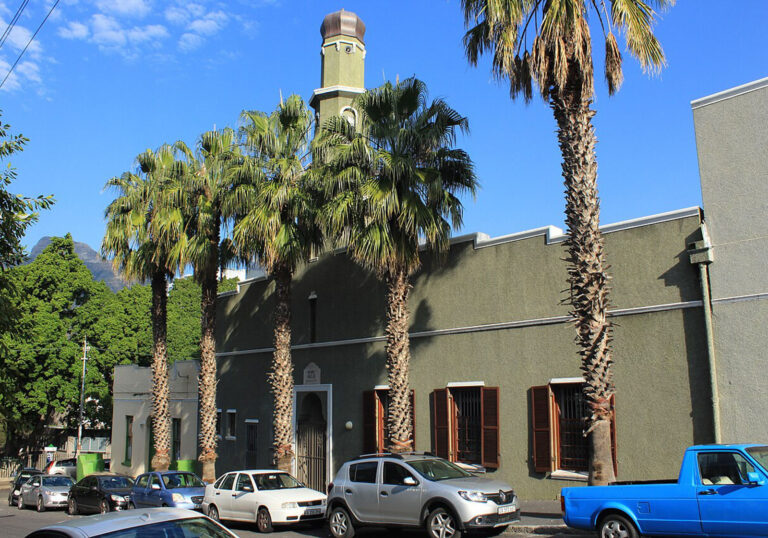
Palm Tree Mosque sits on the eastern side of Long Street, a green-painted double-storey building wedged between a brick warehouse and a blue apartment block, with a single tall palm growing out of the pavement in front of it. A small green sign above the door carries its name. Nothing about it announces itself as a landmark, and the scale is domestic rather than religious: sash windows with white surrounds, a plain parapet, and a front door that sits noticeably low against the kerb. It is the second mosque established in Cape Town, and it has been in Muslim use for more than two centuries.
The building came first. Long Street was residential in the eighteenth century, and the plot passed through a series of owners before Carel Lodewijk Schot acquired it in 1787 and put up a house on it the following year. That house, not a mosque, is the structure that survives. Anyone reading a date of 1788 against this building is reading the date of a private residence.
What made it a mosque was a quarrel. Tuan Guru, the exiled Tidore prince who had founded South Africa’s first madrasah and led the congregation at the Auwal Mosque in Bo-Kaap, died in 1807. Before his death he had named Abdulalim as imam and entrusted Achmat van Bengalen with his spiritual authority. Frans van Bengalen, who had commanded a Muslim artillery unit at the Battle of Blaauwberg and who had been granted the land for the Tana Baru cemetery two years earlier, wanted the position to go instead to Jan van Bougies. Achmat refused to set aside the appointment Tuan Guru had made. Frans and Jan bought the Long Street house and began a separate congregation there.
It very nearly failed. The first imam at Long Street was Abdolgamiet, a brother-in-law of Achmat van Bengalen, and within about a year he and most of the congregation had gone back to Auwal. Frans van Bengalen left the Cape for Batavia. Jan van Bougies was left with the house and a much reduced following, took over as imam in 1808, and is recorded as sole owner of the property by 1811. The rivalry between the two congregations did not fade quickly, and a further dispute over who held the position of chief imam at the Cape was still being contested in the 1830s.
Jan van Bougies is the reason the mosque survived, and his own history is unusual. He was born in the southern part of Celebes, now Sulawesi, among the Bugis people, which is where the name recorded at the Cape as Boughies comes from. He was brought to the Cape as a slave in the latter part of the eighteenth century, already literate in Arabic and in his own language. He was bought by Salia van Macassar, a free Muslim woman, who freed him and then married him according to Muslim rites. He worked as a candle-maker and taught Arabic at Tuan Guru’s madrasah. When Salia died he inherited her estate and used part of it to buy the freedom of other enslaved people. He led the Long Street congregation until his death in 1846.
After he died his second wife, Sameda van de Kaap, dedicated the property as a mosque in his memory. The name she used for it, De Kerk van Jan van Boughies, is why the building is still sometimes called the Church of Jan van Bougies, a Dutch turn of phrase applied to a Muslim place of worship that says something about how the early Cape recorded its Muslim community.
The conversion of the house into a mosque was gradual and came later than the congregation. Architectural records place the physical work in the second decade of the nineteenth century, with a second storey added somewhere between about 1811 and 1821, and catalogues of Cape buildings date the mosque phase to those years rather than to 1807. The two dates describe different things. The congregation begins in 1807; the building becomes a mosque afterwards. The style is usually described as Cape Georgian with vernacular elements, and there is no minaret and no dome, only a mihrab and minbar set into what was once a domestic interior.
The low windows and the shortened front door are the most obvious thing a visitor notices, and they are not a design decision. Long Street has been resurfaced and raised repeatedly over two centuries, and the building has stayed where it was, so the pavement has gradually climbed towards the sills. It is the only surviving eighteenth-century house on Long Street, and the architectural historian Hans Fransen described it as the street’s oldest substantially unaltered building, which is a narrower claim than it first sounds and a fair one. The street around it has been rebuilt several times over; the mosque has not.
The palms give the mosque its name. Photographs going back to the 1870s show two tall palms standing in front of the building. One of them came down in a south-easter, apparently in the early 1960s, and a replacement was planted in 1965; a framed photograph inside the mosque records the planting. One of the original pair still stands, and sections of the trunk of the tree that fell are said to be used as stools inside. The alternative name Dadelboom Mosque, from the Afrikaans for date tree, comes from the same association, although the species of the original palms was never formally identified.
Palm Tree Mosque remains an active mosque and is not run as a visitor attraction. The imam’s family lives in the building and looks after it, and the front rooms are cleared for prayer when the congregation is larger. Neither the mosque nor any heritage or community body publishes opening hours, prayer times, admission arrangements, dress guidance or photography rules for it, and there is no listed telephone number, website or email. Several self-guided walking routes through the city centre include the building, but none of them advertise going inside.
What a visitor can rely on is the street view, and it is worth the short detour. Standing on the pavement opposite, the contrast is the point: a small late Georgian house, still doing the job it was adapted for in the early nineteenth century, holding its ground on a street given over to bars, hostels, bookshops and traffic. The Auwal Mosque, where this congregation began, is a fifteen-minute walk uphill into Bo-Kaap.
Highlights
- Cape Town’s second mosque congregation, established on Long Street in 1807
- An eighteenth-century private house rather than a purpose-built mosque
- Founded after the dispute over the succession that followed Tuan Guru’s death
- Led for nearly forty years by Jan van Bougies, a freed man from Sulawesi
- The only surviving eighteenth-century house on Long Street, its windows now low against a raised pavement
- Named for the palms that stood in front of it, where a palm still grows
Tips
This is an exterior stop. The building reads best from the pavement on the opposite side of Long Street, where the full width of the facade and the palm are visible and the low set of the windows and door against the raised street is obvious. Nothing about visitor access is published, so do not count on going inside.
Frequently Asked Questions
When was Palm Tree Mosque built?
Three different dates apply to three different things. The house was built as a private residence in about 1788, on a plot bought by Carel Lodewijk Schot the year before. The congregation dates from 1807, when the property was bought by Frans van Bengalen and Jan van Bougies. The physical conversion of the house into a mosque, including the addition of a second storey, followed in the second decade of the nineteenth century. The building was not constructed as a mosque and was not built in 1807.
Is Palm Tree Mosque the second-oldest mosque in South Africa?
It is generally described that way, after the Auwal Mosque in Bo-Kaap. Heritage documentation prepared for the Auwal declaration, E. M. Mahida’s history of Muslims in South Africa and the Artefacts architectural register all treat the 1807 Long Street congregation as the second in Cape Town, and no rival claim to that position appears in the record. The ranking refers to the founding of the congregation rather than to the age of the building, which is a separate matter.
Why is it called Palm Tree Mosque?
Two tall palms stood in front of the building, and photographs of them go back to the 1870s. One came down in a south-easter in the early 1960s and a replacement was planted in 1965. One of the original pair still stands on the pavement outside. The alternative name Dadelboom Mosque comes from the Afrikaans for date tree, though the species of the original palms was never formally recorded.
Who founded Palm Tree Mosque?
Frans van Bengalen and Jan van Bougies bought the Long Street house in 1807 after Achmat van Bengalen declined to set aside the appointment Tuan Guru had made at the Auwal Mosque. The first imam at Long Street was Abdolgamiet, but he and most of the congregation returned to Auwal within about a year and Frans van Bengalen left the Cape. Jan van Bougies took over as imam in 1808 and led the congregation until his death in 1846, and it is largely because of him that the mosque continued.
Can visitors go inside Palm Tree Mosque?
It is a working mosque with the imam’s family living in the building, and it is not set up to receive visitors. No opening hours, admission arrangements, dress guidance or photography rules are published by the mosque or by any heritage or community body, and there is no listed telephone number, website or email. Walking routes through the city centre point the building out from the street, but none of them advertise going inside. Treat it as an exterior stop.
Is Palm Tree Mosque still active?
Yes. It has been in continuous Muslim use since the early nineteenth century and remains an active congregation. The imam’s family lives in and maintains the building, and the front rooms are cleared for prayer when the congregation is larger.