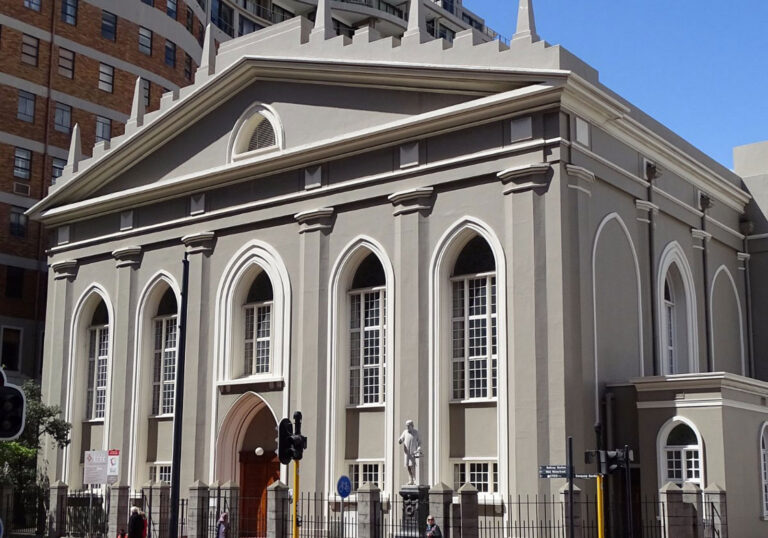
Auwal Mosque on Dorp Street is the oldest mosque in South Africa and remains an active congregation rather than a historic interior kept for visitors. Muslim religious use of the site dates from 1794, the first madrasah in the country opened here a year earlier under Tuan Guru, and the teaching done in this building produced some of the earliest written Afrikaans. The mosque publishes no visiting hours, so seeing the interior depends on arranging it in advance or joining a Bo-Kaap tour that goes inside.
Auwal Mosque stands on Dorp Street, on the lower slope of Bo-Kaap, in a terrace that gives very little away from the pavement. The frontage is long and low, rendered in a dark grey green, with brown shuttered windows and a small arched doorway set back under a name plaque. A slender minaret with a copper dome rises behind the roofline, and the palms along the kerb hide most of it. Visitors photographing the painted houses higher up the hill often walk past without registering what they have passed. This is the oldest mosque in South Africa, and it is still in daily use.
The date attached to Auwal is 1794, and the congregation keeps it: in September 2024 it marked 230 years. What happened in that year is more particular than the familiar phrase “built in 1794” suggests. The property was a warehouse belonging to Coridon van Ceylon, a freed man and one of the first Muslims to own property in Cape Town, who bought two adjoining Dorp Street plots on 26 September 1794. The building was brought into Muslim religious use by the construction of a mihrab, the niche that marks the direction of prayer. That was a change of use, not a building project.
The structure visitors see came later. The City of Cape Town’s heritage record for Bo-Kaap dates the erection of the original purpose-built mosque to between 1809 and 1814, and notes that the title still stands in the name of Saartjie van de Kaap, Coridon’s daughter, to whom the property passed. Extensive rebuilding followed in 1936, and a survey of the building in the 1980s found only two of the original walls intact. Auwal’s continuity is therefore a continuity of congregation and of ground rather than of masonry. The 1794 date belongs to the founding of the mosque and to the beginning of worship on the site it still occupies.
Teaching arrived before the mosque did. Around 1793, in the same Dorp Street warehouse, Tuan Guru opened the first madrasah in South Africa. He was Imam Abdullah ibn Kadi Abdus Salaam, born in 1712 on Tidore in the Ternate islands, in what is now eastern Indonesia, where he held religious and judicial office at the sultan’s court. Dutch East India Company records state that he had conspired with the English against Dutch interests, and he was banished to the Cape, arriving on 6 April 1780 aboard the Zeepard at the age of sixty-eight. His years of confinement are associated with Robben Island, although how long he was held there, and whether without interruption, is not settled. While in custody he completed a substantial work on Islamic jurisprudence in 1781 that became a standard reference for Cape Muslims through the nineteenth century. He was free by 1793 and spent the rest of his life teaching. He died in 1807 and is buried at the Tana Baru cemetery above Bo-Kaap.
The school mattered at least as much as the mosque that grew around it. It was open to enslaved people and to the Free Black community, neither of whom had access to colonial schooling, and it grew quickly: roughly 375 pupils by 1807 and 491 by 1825. For many of them it was the only formal education available, and it was education in literacy as much as in religion.
That has a consequence which reaches well beyond the congregation. Teaching at the madrasah moved over time from Malay into the Dutch spoken at the Cape, but it continued to be written in Arabic script, because Arabic letters were what the pupils learned first. The religious texts produced this way are known as Arabic-Afrikaans, and they are among the earliest surviving written records of the language that became Afrikaans. One of the more consequential things ever to happen in a Cape Town classroom happened in this one.
For most of the Dutch period, public Muslim worship at the Cape was not permitted. Prayer took place privately or out of sight, and congregational prayers were held for a time in a quarry on Chiappini Street before the Dorp Street property became available. The prohibition lapsed after the British occupation of 1795, and in 1804 the Batavian administration under de Mist extended legal standing to religious societies at the Cape. Auwal’s early congregation was drawn largely from enslaved people and from Free Blacks, and for several decades the mosque was the principal Muslim institution in the colony.
On Tuan Guru’s death in 1807 the imamate passed to Achmat van Bengalen, the husband of Saartjie van de Kaap, and stayed in that family until 1981. The succession was contested, and part of the congregation broke away to found Cape Town’s second mosque, the Palm Tree Mosque on Long Street. Saartjie’s will later tied the Dorp Street property to use as a mosque.
A handwritten Qur’an attributed to Tuan Guru, who is said to have written out copies from memory, is associated with the mosque. One manuscript was found at Auwal during renovation work in the 1980s, restored over three years by Cape scholars, and has since been exhibited at the mosque in a protective case, a measure taken after attempts to steal it. Researchers who have worked on the manuscripts describe more than one copy, with others held by descendants of Tuan Guru. Whether the manuscript can be seen on a given day is not something the mosque publishes. It is not held by the Bo-Kaap Museum, where visitors sometimes expect to find it.
Auwal is an active mosque before it is anything else. Two imams lead it, daily prayers are held, a dhikr gathering meets on Thursday evenings, and children are still taught here through the academy that continues the madrasah’s work. Recent years have also brought pressure from outside: a proposed hotel development on nearby Buitengracht Street was contested through 2025 by the Bo-Kaap civic association on the grounds of the mosque’s standing, and local heritage figures have raised concerns about the effect of tourism on the neighbourhood.
The mosque publishes no visiting hours, no tour arrangements and no visitor guidance, and the opening times that appear on mapping and review sites do not come from it. Several Bo-Kaap walking tours include Auwal; some state plainly that they go inside, others describe entry as possible between prayers. Arriving unannounced may well find the door shut. Anyone hoping to see the interior is best served by writing to the mosque beforehand at info@auwalmasjid.co.za, or by choosing a Bo-Kaap tour that says explicitly that it enters. Dorp Street is a residential street and the building is in constant religious use, both of which are worth carrying with you. From the doorway it is a short walk uphill to the Bo-Kaap Museum on Wale Street and to the painted terraces, and a longer climb to the Noon Gun on Signal Hill.
Highlights
- The oldest mosque in South Africa, in Muslim religious use on the same Dorp Street site since 1794
- Founded around the first madrasah in the country, opened by Tuan Guru about a year earlier
- The teaching tradition that produced Arabic-Afrikaans, among the earliest written forms of the language
- A handwritten Qur’an attributed to Tuan Guru, recovered at the mosque during renovations in the 1980s
- The original purpose-built mosque dated by the City of Cape Town to between 1809 and 1814
- An active congregation with daily prayers, a Thursday dhikr gathering and a working madrasah
Tips
Nothing about visitor access is published by the mosque, so write to info@auwalmasjid.co.za in advance if you hope to see the interior, or choose a Bo-Kaap walking tour whose itinerary states that it goes inside. Treat the building as a place of worship in daily use rather than a monument, and keep in mind that Dorp Street is residential.
Frequently Asked Questions
Is Auwal Mosque the oldest mosque in South Africa?
Yes. Auwal is accepted as the country’s first mosque and its congregation has used the same Dorp Street site since 1794. The Palm Tree Mosque on Long Street, founded in 1807 by a group that broke away from Auwal, is the second oldest, and parts of its building are older than anything standing at Auwal today.
Was Auwal Mosque built in 1794?
Not the building you see. In 1794 an existing warehouse on the site was brought into use as a mosque by adding a mihrab, the niche marking the direction of prayer. The City of Cape Town dates the first purpose-built mosque here to between 1809 and 1814, and extensive rebuilding took place in 1936. Very little original fabric survives, so 1794 marks the founding of the mosque rather than the age of the structure.
Can you visit Auwal Mosque?
It is a working mosque and does not operate as a visitor attraction. It publishes no opening hours, no admission arrangements and no tour information, and the hours shown on mapping and review sites do not come from the mosque. Some Bo-Kaap walking tours enter the building and say so on their itineraries. Otherwise the practical route is to write to the mosque in advance at info@auwalmasjid.co.za. Visitors who simply turn up may find the door closed.
Who was Tuan Guru?
Imam Abdullah ibn Kadi Abdus Salaam, born in 1712 on Tidore in the Ternate islands, held religious and judicial office there before the Dutch East India Company banished him to the Cape for conspiring with the English. He arrived in April 1780 and his confinement is associated with Robben Island, where he completed a major work on Islamic jurisprudence in 1781. Free by 1793, he opened South Africa’s first madrasah and led the congregation at Auwal until his death in 1807. He is buried at the Tana Baru cemetery above Bo-Kaap.
What is Arabic-Afrikaans and what does it have to do with the mosque?
Teaching at the Auwal madrasah shifted over time from Malay into the Dutch spoken at the Cape, but continued to be written in Arabic script because that is the script the pupils learned first. The religious texts produced this way are known as Arabic-Afrikaans and count among the earliest surviving written records of the language that became Afrikaans. The school was open to enslaved people and to the Free Black community, who had no access to colonial schooling.
Can you see Tuan Guru’s handwritten Qur’an?
A manuscript attributed to him was found at the mosque during renovations in the 1980s, restored, and has been exhibited there in a protective case. More than one copy is known and others are held by his descendants. The mosque does not publish anything about viewing it, so there is no way to say in advance whether it can be seen on a given day. It is not held by the Bo-Kaap Museum, where visitors sometimes expect to find it.