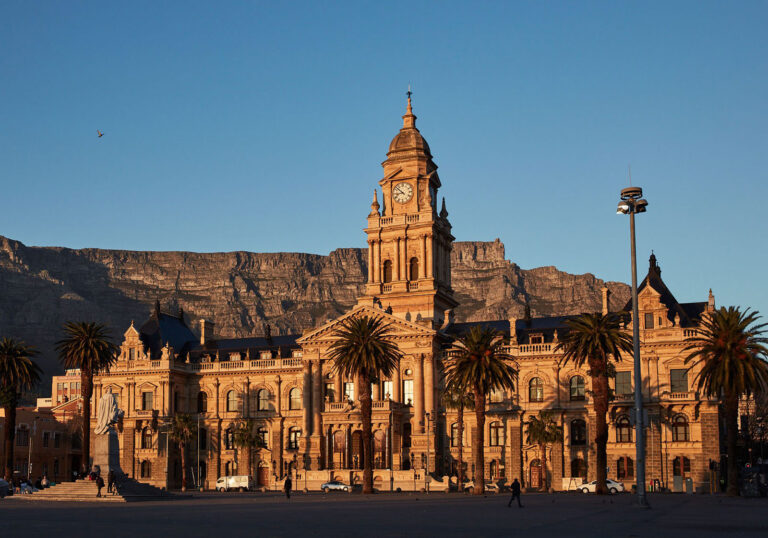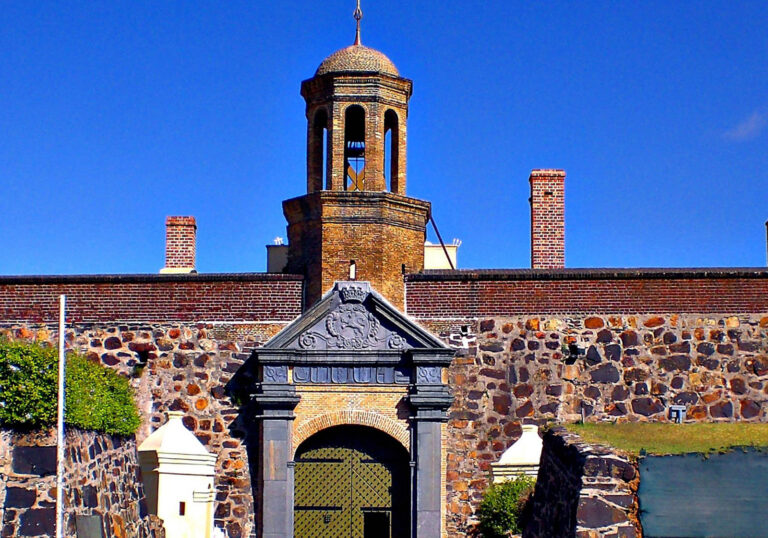
Groote Kerk stands on Adderley Street at the edge of Church Square, in the oldest part of colonial Cape Town. The congregation dates from 1665 and is the oldest in South Africa, but the building visitors see was consecrated in 1841, and only the clock tower survives from the church that stood here before it. It is still an active congregation rather than a museum, and the interior is open for viewing at set hours.
Groote Kerk stands on Adderley Street in the middle of Cape Town’s business district, hemmed in by office blocks and traffic. The front is a broad painted gable with a classical pediment, a row of small pinnacles along the roofline, and tall windows that come to a Gothic point — an unusual combination that makes the building hard to place stylistically and easy to recognise. It is large, plain and pale, and it holds its ground against much taller neighbours. A separate clock tower rises beside it, darker and visibly older than the church it adjoins.
The name means “great church” in Dutch, and the congregation behind it is the oldest in South Africa. Reformed worship arrived with the Dutch East India Company in 1652, when services were held in the fort and led by lay readers. The first communion was administered in May 1652 and the first baptism the following year. The congregation dates itself formally to August 1665, when the first permanent minister, Joan van Arckel, arrived at the Cape. For a period in the 1670s services were held in De Kat at the Castle of Good Hope.
The building came later, and this is where the history is most often got wrong. Foundations for a church on this site were laid in 1678. The cornerstone of a cross-shaped church was laid by Governor Willem Adriaan van der Stel in December 1700, and that church was consecrated in January 1704. It was altered over the following century — the walls were pushed outwards and the cruciform plan was lost — and the structure eventually proved unsound enough to be demolished. The church standing today was consecrated on 31 January 1841, one hundred and thirty-seven years after the first, built by Hermann Schutte on the same ground at roughly ten times the cost. Only the tower of the older church was kept. So the congregation dates from the 1660s, the site has been in church use since the 1670s, and the building itself is from 1841 — three separate dates that are easy to collapse into one.
That history matters because the Dutch Reformed Church was effectively the established church of the Cape under Company rule, and this was its first congregation. Every Dutch Reformed congregation in the country traces back to it. For most of the colonial period, membership here was bound up with civic standing in a small settlement where church, company and government were barely separable.
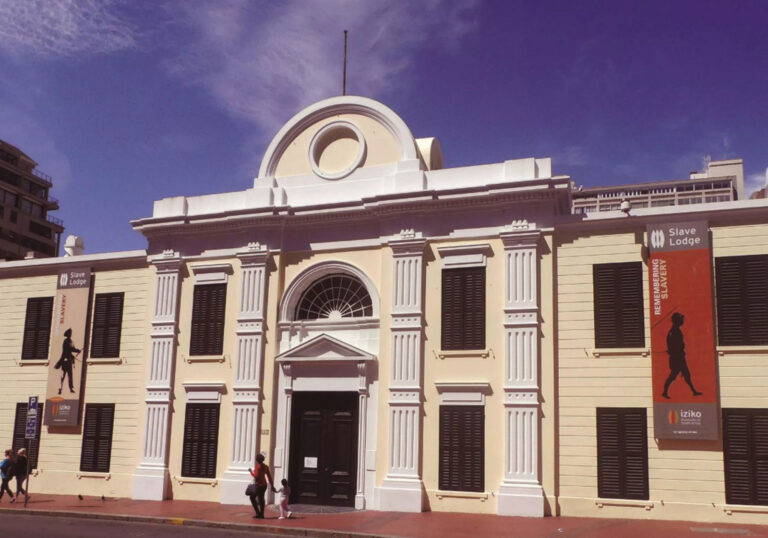
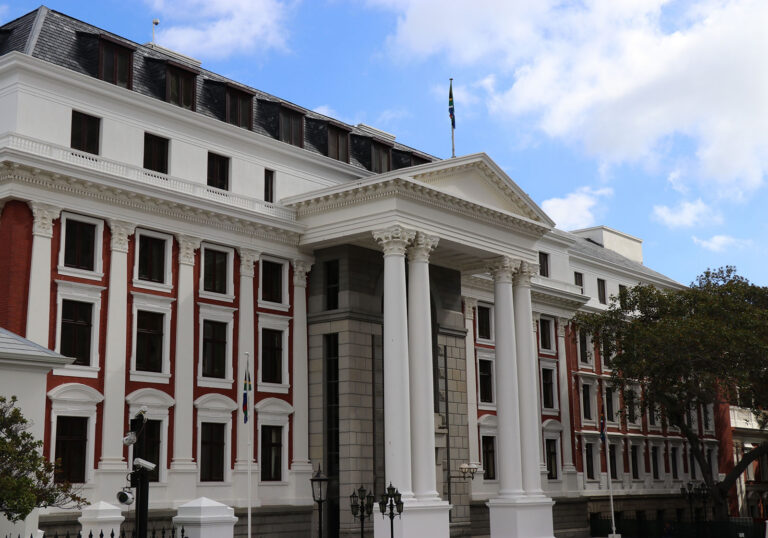
That entanglement is legible in the streets around the building. Church Square lies just behind the church, at the corner of Parliament and Spin Streets, and within a couple of hundred metres you can stand between the church, the old Slave Lodge at the top of Adderley Street, and Parliament. The Slave Lodge was built by the Dutch East India Company to house the enslaved people it owned, later served as the colony’s supreme court, and is now a museum. A plaque on a traffic island in Spin Street marks the slave market that operated on the square, and a memorial on the square itself remembers the people sold here. The full account belongs to the Slave Lodge, but the geography is the point: the church, the courts, the government and the slave market shared one small block.
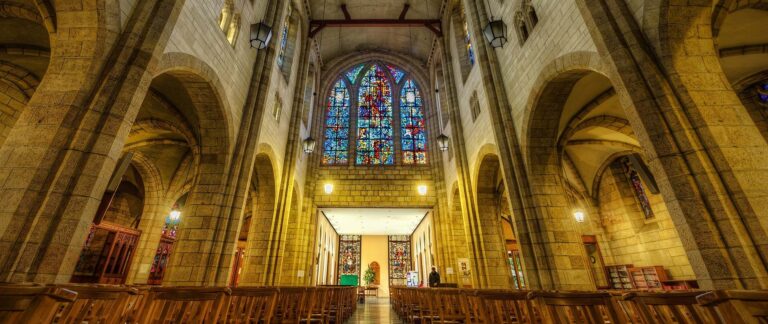
If the church is open, the interior repays the few minutes. The pulpit was carved by Anton Anreith from Indian hardwood and inaugurated in November 1789; its bowl rests on the shoulders of two carved lions, each holding a wreath. The organ is very large, with 5 917 pipes, four manuals and a console of 102 stops, and the roof lights above are shaped as proteas. Communion silver more than three hundred years old is still held here, and a number of figures from South African history are buried in the building.
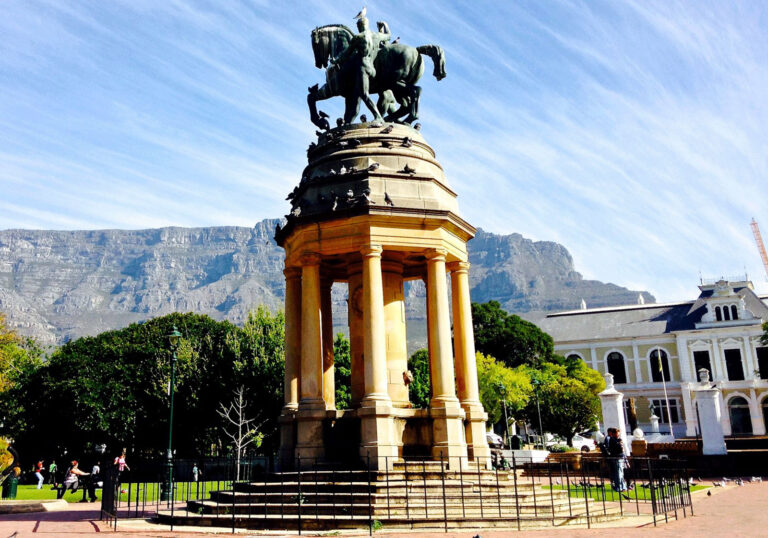
As a visit this is short and undemanding. The church publishes a viewing period from 10:00 to 14:00, though its published wording does not clearly specify which days that applies to. It remains a working congregation rather than a preserved monument, with a Sunday morning service in the traditional style and organ music, so access also changes around services and church events. Check current access before making a special trip. Groups can arrange a guided visit with the church in advance. Outside viewing hours the exterior, the tower and Church Square are still readable from the pavement, and the Slave Lodge, St George’s Cathedral, Company’s Garden and Parliament are all within a few minutes’ walk.
Highlights
- South Africa’s oldest Dutch Reformed congregation, formally dated to August 1665
- The present church, consecrated on 31 January 1841 on the same site
- A clock tower kept from the earlier church of 1704, older than the building beside it
- Anton Anreith’s 1789 pulpit, its bowl carried on two carved lions
- A pipe organ of 5 917 pipes, four manuals and a console of 102 stops
- Church Square, the Slave Lodge and Parliament within a few minutes’ walk
Frequently Asked Questions
How old is Groote Kerk?
There are three answers, depending on what is being asked. The congregation is the oldest in South Africa and dates itself to August 1665. There has been a church on this site since the 1670s, and the first church building here was consecrated in 1704. The building standing today was consecrated in 1841. Only the clock tower survives from the earlier church.
Can you go inside Groote Kerk?
Yes, at set times, but the details are worth checking. The church publishes a viewing period from 10:00 to 14:00, though its published wording does not clearly specify the applicable days. It is a working congregation rather than a museum, so access also changes around services and church events. Check current access before making a special trip. Groups can arrange a guided visit with the church in advance.
What is Church Square?
The small square behind the church, at the corner of Parliament and Spin Streets. It was the centre of the old colonial town, and a slave market operated here. A plaque on Spin Street and a memorial on the square mark that history. Parliament, the Slave Lodge and Company’s Garden are all a short walk away.
How is Groote Kerk different from St George’s Cathedral?
They are a couple of blocks apart and belong to different stories. Groote Kerk is Dutch Reformed and belongs to the earliest colonial city, so its interest is the age of the congregation, the 1841 building and the setting on Church Square. St George’s is Anglican and is best known for its part in South Africa’s twentieth-century opposition to apartheid.
What else is worth seeing nearby?
The Slave Lodge is at the top of Adderley Street, St George’s Cathedral is on Wale Street, and Company’s Garden runs up behind them. Parliament borders Church Square, and the Grand Parade, City Hall and the Castle of Good Hope are a short walk to the east.