Church Square is a small paved public square behind Groote Kerk, at the corner of Spin and Parliament Streets in central Cape Town. Enslaved people were sold at public auction on this corner in the decades before abolition, and a memorial of eleven granite blocks, unveiled in 2008, now stands on the paving. It is a short stop, valuable for what it explains rather than what it looks like.
Church Square is a small paved square in the middle of Cape Town’s city centre, set behind Groote Kerk at the corner of Spin and Parliament Streets. There is no gate, no ticket and no building to enter, and the whole space can be crossed in well under a minute. What makes it worth stopping for is that this one block held the Dutch East India Company’s slave lodge, the colony’s first church, its highest court and, for a period in the nineteenth century, the ground where enslaved people were sold at public auction. Church Square is where those things touched each other.
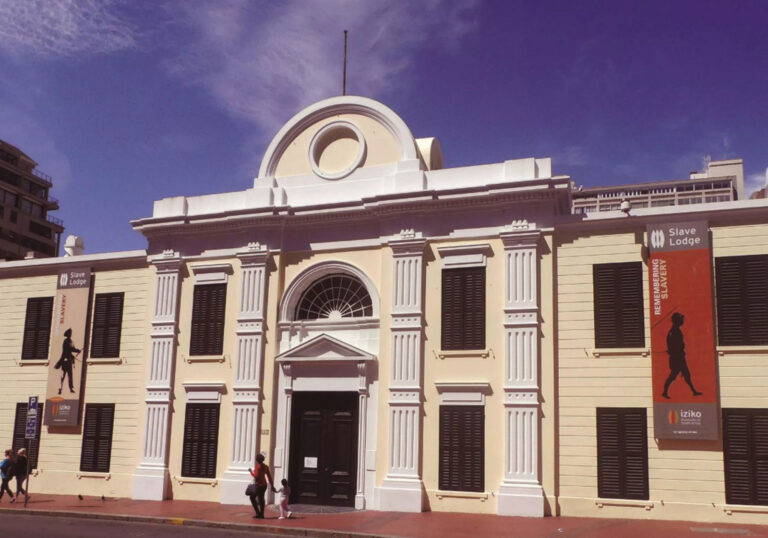
The square was never laid out as a civic set piece. It began as unused ground at the lower end of the Company’s Garden, and its shape was settled by whatever was built around it. The Company’s slave lodge, at the top of what is now Adderley Street, closed off one side in the last decades of the seventeenth century. The Dutch Reformed congregation built on the southern side at the start of the eighteenth century, and that is where the name comes from: Kerkplein, the church square. On the eastern side a silk spinning works operated briefly from the 1720s, and the lane beside it took the name Spin Street, which it still carries. Enslaved children carried silkworm cocoons between that factory and the lodge door.
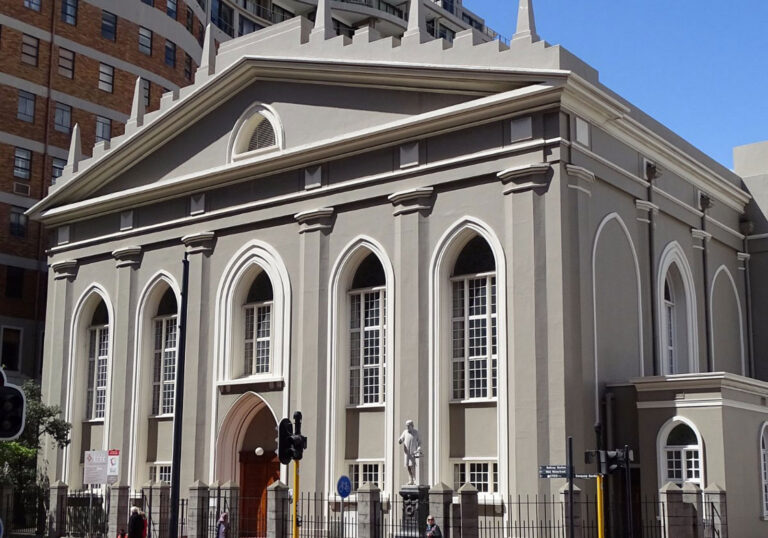
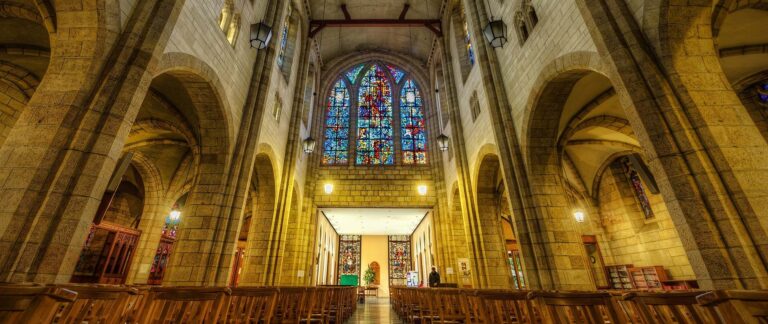
Groote Kerk gave the square its name and its weekly rhythm. Congregants came in from farms across the peninsula, and the enslaved people who drove them waited outside with the wagons while services ran. Company edicts had forbidden enslaved people from gathering at the church entrances during worship, which pushed that waiting out onto the open ground. The church has its own long and frequently misdated history, and that account belongs to its own page. The effect on the square is the point here: for most of the eighteenth and early nineteenth centuries this was where the enslaved population of a church going town spent its waiting hours.
A large fir tree stood at the Spin Street corner, in front of a drapery shop, and it is the feature most closely associated with the site. The tree was cut down to a stump by the city council on 9 November 1916. In November 1951 the stump and its bronze plaque were removed when Spin Street was widened, and a small octagonal memorial was built on the traffic island the widening created. Its bilingual inscription is brief: “On this spot stood the old slave tree.”
The story attached to that tree has been corrected more than once, and the corrections are worth knowing. The first plaque, put up by the shopkeeper Alfred Hilliard after the tree came down, described enslaved people being displayed on tables and sold beneath it, and the tree was popularly held to date from Van Riebeeck’s time. The botanist Edith Stephens later examined it and put its planting at around 1786, which ruled out the older claim about its age. The auctions themselves are documented. Official sales of enslaved people were held at this corner from 1826, run first by the Sequestrator’s Department and afterwards by the High Sheriff, largely to settle insolvent and sequestrated estates. In 1827 alone 212 people were sold. A May 1829 advertisement listed Hannibal, aged thirty, William, aged thirty five, and Nancy, to be sold by public auction under the trees. The sales fell away in the early 1830s and ended shortly after abolition.
One person keeps the tree in view. A man known as Joemat, who had been enslaved and was later free, kept a fruit and sweet stall beneath it for about thirty five years. His obituary in the Cape Times in 1898 recorded that he had been bought and sold on the same ground where he traded, and his presence there is part of why the spot was marked at all.
Legal emancipation came at midnight on 1 December 1834, followed by four years of compulsory apprenticeship that ended in 1838. After that the square carried on as ordinary city ground. Office buildings replaced the older structures around it, including the National Mutual Life Association building that still dominates the eastern side, and for much of the twentieth century the open ground was used for parked cars. It was declared a national monument on 17 February 1961, which protected the space without changing how it was used. The parking was cleared later and the ground repaved as a pedestrian square.
The memorial to the enslaved was unveiled on the paving in 2008, two hundred years after the 1808 revolt that began on farms in the Swartland and ended at Salt River. It was made by Wilma Cruise and Gavin Younge and consists of eleven granite blocks. Nine stand in a loose grid on the open paving near the slave tree plaque, and two sit on a raised plinth at the south western corner, closest to the Slave Lodge. The blocks share a common footprint but differ in height, which the artists intended to read as common humanity on the one hand and growth on the other. Their top surfaces are polished to a mirror finish, so anyone standing over one sees sky, surrounding buildings and their own reflection. The blocks carry engraved text drawn from the history of slavery at the Cape, including resistance and emancipation.
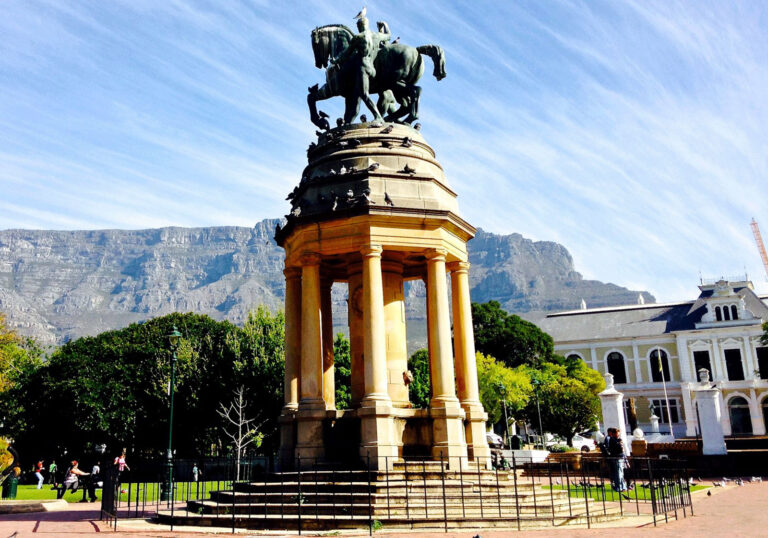
The memorials on the square do not sit easily together, and that is part of what there is to see. The bronze figure on the tall stone plinth is Jan Hendrik Hofmeyr, known as Onze Jan, a Cape parliamentarian and newspaper editor who died in 1909. It was modelled by Anton van Wouw and paid for by public subscription. In 2015 the plinth was wrapped in white cloth carrying the line “A black woman raised me”, an artwork by Kenan Petersen and Pola Maneli that appeared during the period of protest against colonial statues. On 1 December 2024, Emancipation Day, a gathering organised by the Prestwich Place Project Committee, the District Six Museum and the Institute for the Healing of Memories symbolically renamed the space Freedom Square. That renaming is symbolic rather than official, and the maps still read Church Square.
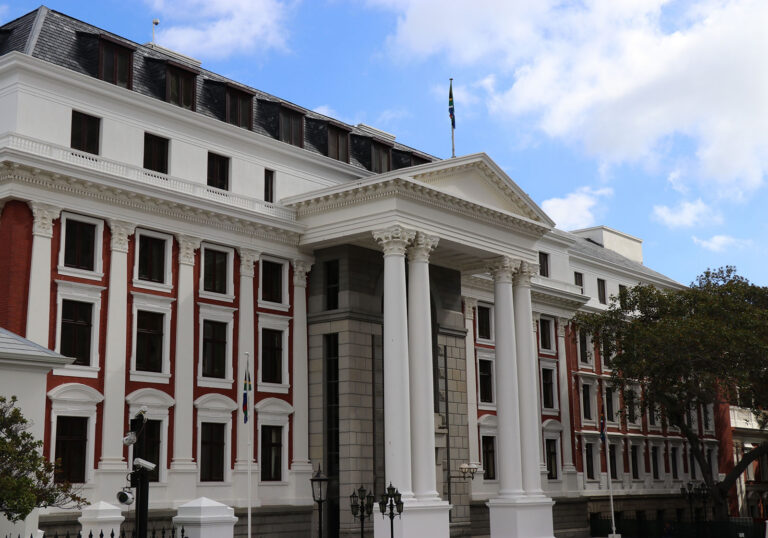
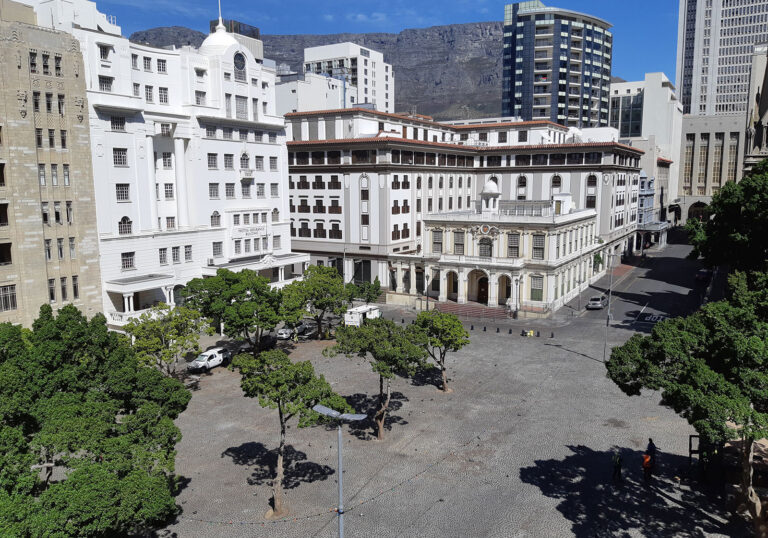
Physically the square is modest. It is a roughly rectangular paved area, small enough to take in at a glance, with Spin Street and Parliament Street running along its edges rather than through the middle, and bollards keeping vehicles off the paving. There are trees in large planters, some seating, and the Iziko Social History Centre sign on the National Mutual building, which is a collections and archive facility open by appointment on weekdays rather than a walk in museum. Groote Kerk’s tower stands immediately behind and the Slave Lodge is at the far corner. Ten to twenty minutes covers it: enough to read the memorial, cross to the plaque on the Spin Street island and look properly at the buildings around the edge. The value here is understanding rather than spectacle.
There is no admission and nothing to book. This is open ground in a working part of the city, busiest on weekday mornings when Parliament and the surrounding offices are in use, and quiet at weekends. Reaching the slave tree plaque means crossing a live road to a traffic island. Ordinary city centre care applies after dark. Parking means a metered bay or a garage in the surrounding blocks, since the square itself has none.
Highlights
- Eleven granite blocks by Wilma Cruise and Gavin Younge, unveiled in 2008 as a memorial to the enslaved
- The Spin Street island plaque marking where the old slave tree stood until 1916
- Documented public auctions of enslaved people held at this corner from 1826 until abolition
- Groote Kerk’s tower and the old Slave Lodge facing the same small open space
- Anton van Wouw’s bronze of Jan Hendrik Hofmeyr, Onze Jan, on its tall stone plinth
- A national monument since February 1961, repaved as a pedestrian square after years as a car park
Frequently Asked Questions
What is Church Square in Cape Town?
Church Square, or Kerkplein, is a small paved public square in Cape Town’s city centre, behind Groote Kerk at the corner of Spin and Parliament Streets. It takes its name from the church built on its southern side at the start of the eighteenth century. The Dutch East India Company’s slave lodge stood on the other side, and the square is best known today for its connection to slavery at the Cape and for the memorial to the enslaved that stands on the paving.
Were enslaved people really sold at Church Square?
Yes. Official auctions of enslaved people were held at this corner from 1826, run first by the Sequestrator’s Department and afterwards by the High Sheriff, largely to settle insolvent and sequestrated estates. In 1827 alone 212 people were sold. The popular version of the story places every sale beneath the old fir tree, and that version comes from a plaque put up after the tree was felled in 1916. The tree proved to be younger than the plaque claimed, but the auctions at this corner are documented.
What is the memorial on Church Square?
It is a memorial to the enslaved, unveiled in 2008 and made by Wilma Cruise and Gavin Younge. It consists of eleven granite blocks, nine set in a loose grid on the open paving and two on a raised plinth at the corner nearest the Slave Lodge. The blocks share a footprint but vary in height, and their polished top surfaces reflect the sky and the buildings around the square. They carry engraved text drawn from the history of slavery at the Cape.
Where is the slave tree plaque?
On a traffic island in Spin Street, a few steps from the square itself. The small octagonal memorial there was built in 1951, when the original stump and its plaque were removed to widen the street. Reaching it means crossing a live road.
How long do you need at Church Square, and is there an entrance fee?
There is no admission charge and nothing to book. Ten to twenty minutes covers most visits, which is enough to read the memorial, cross to the slave tree plaque and look properly at the buildings around the edge.
What is the difference between Church Square and Groote Kerk?
Groote Kerk is the church. Church Square is the open public space behind it. The congregation is the oldest in South Africa and the building standing today dates from 1841, and that history belongs to the Groote Kerk page. The square is a separate subject: the ground the church shared with the Company’s slave lodge, the colony’s highest court and, for a period, its slave auctions.