St Stephen’s Church on Riebeeck Square was built in 1800 as the African Theatre, the first purpose-built theatre in South Africa, at the instance of Governor Sir George Yonge. It staged the earliest recorded Shakespeare performance in southern Africa in 1801. After theatre-going fell out of favour the building was sold in 1839 and adapted as a school and church for people freed from slavery at the end of apprenticeship. It entered the Dutch Reformed Church in 1857 as a full congregation rather than a mission, remains one today, and still shows the oval windows and urn-topped buttresses of the theatre it began as.
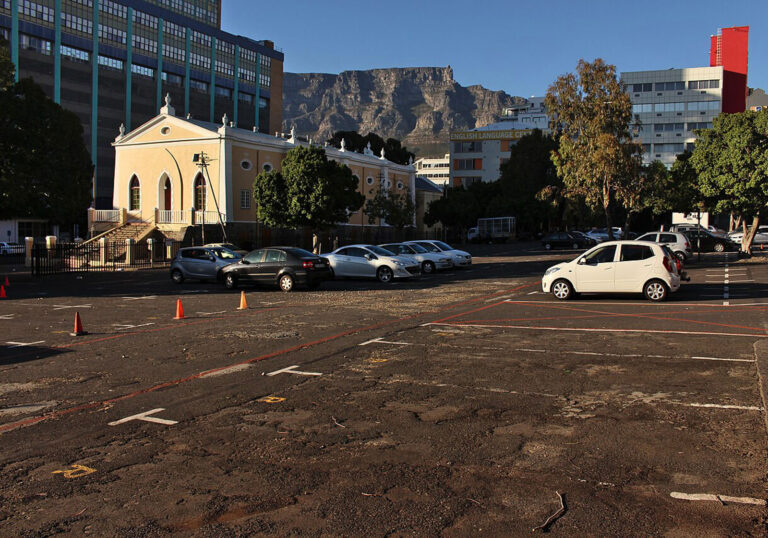
St Stephen’s Church stands on the Bree Street edge of Riebeeck Square, a long pale yellow building behind a low stone wall and a row of parked cars. At a glance it reads as a modest nineteenth century church: a pedimented front, pointed windows with white surrounds, steps up to the door. The giveaway is higher up. Set into the wall above the windows is a row of small oval openings, and along the roofline a line of buttresses each capped with a stone urn. Neither belongs to church architecture. They are what survives of the building this was designed to be, which was the first purpose-built theatre in South Africa.
The idea came from a group of British garrison officers and townspeople who petitioned the governor of the first British occupation, Sir George Yonge, to establish a subscription theatre. Yonge took it up as a personal project. He appropriated a portion of the Boerenplein, the open ground now called Riebeeck Square, passed a section of it to a committee of shareholders, designed the building himself and paid for much of it out of his own pocket. No professional architect is recorded. Lady Anne Barnard, writing on 28 July 1800, noted that the governor was so taken with the scheme that he went every day to the spot where they were digging the foundations.
An opening night was advertised for 17 November 1800 and did not happen. The theatre finally opened during 1801, and the first production for which a record survives is Shakespeare’s Henry IV Part 1 in October that year, which ran for a week. Lady Anne Barnard described the evening in a letter of 16 October: it began with an address to Apollo written by Mrs Somers and spoken by her husband, and although she thought the play dull, some scenes were very well done. It is the earliest recorded performance of Shakespeare in southern Africa.
The African Theatre, also called the Afrikaansche Schouwburg and known locally as the Komediehuis, was run by its shareholders as a subscription house. The shares were divided between English and Dutch holders and productions were meant to alternate between the two languages, with German and French pieces staged as well. The companies were mostly amateur, drawn from the garrison and from local dramatic societies with names like Tot Nut en Vermaak and Tot Leering en Vermaak, stiffened occasionally by professionals passing through on their way east. Lord Charles Somerset kept a box. Tickets were expensive enough to keep attendance to the colonial elite, and enslaved people were permitted to go ahead and hold seats for their owners but were not allowed to watch.
The building itself was rough work behind its plaster. The walls were Table Mountain sandstone, rough dressed and bonded with clay rather than mortar, and the upper courses were eked out with half burnt brick and rendered over. It had a low pitched roof, buttresses topped with urns, the row of oval windows, and a covered colonnade of four columns reached by two curving stairways. Inside there was no pit at first, only a balcony and ornamented boxes, with a pit added in 1804. The stage was small, with dressing rooms behind it. Underneath the auditorium, at street level, the design provided for shops, workshops and storerooms. The two stairways were pulled down in 1824, which matters more than it sounds: what stands today is the building as it has been since then, not as it was built.
Theatre-going fell out of favour in Cape Town during the 1830s as evangelical feeling hardened against the stage. A correspondent writing as Philemon in the South African Commercial Advertiser in June 1836 attacked attendance as a breach of baptismal vows. Documented productions continue as late as 1838, and in March 1839 the building was sold.
What it was sold for gives the building its second life. Slavery at the Cape ended in 1834, followed by a four year period of apprenticeship that expired on 1 December 1838. On that day Dr James Adamson of St Andrew’s Presbyterian Church and the Reverend G. W. Stegmann, then a Lutheran pastor, held a service for the newly freed at St Andrew’s. It was Adamson’s idea to take the empty theatre and use it as a school. The building was bought the following year, reportedly for £3,484, and adapted as a church for people freed from slavery and a school for their children: classes during the week, worship and Sunday school on Sundays. A congregation formed around 1841 and the church was consecrated on 30 April 1843.
The name is traditionally explained by an incident rather than a dedication. The story is that stones were thrown at the building during a service, and that the congregation took the name of St Stephen, the first Christian martyr, who was stoned to death. It is worth knowing that the accounts do not agree on who threw them. The heritage register and most English retellings say dissatisfied slaves; the Dutch Reformed Church’s own congregational history says dissatisfied slave owners, or slaves according to some sources; another account says people opposed to the establishment of a church for the newly freed. No contemporary record of any such incident is known, and every source that repeats the story marks it as something said rather than something documented.
In 1857 the congregation asked to be taken into the Dutch Reformed Church and was incorporated on 15 November as that church’s seventy-fourth congregation, with representation in its synod. Stegmann was admitted as a Dutch Reformed minister the same year. This was an unusual arrangement: congregations of colour were generally placed in mission or daughter structures rather than admitted to the mother church, and St Stephen’s is often described as the only Dutch Reformed congregation named after a saint. The 1857 decision still shapes the building. Because St Stephen’s was never a mission congregation, it was not part of the mission church that merged into the Uniting Reformed Church in 1994, and it remains within the Dutch Reformed Church today.
The twentieth century nearly took it. By 1936 the building was in poor condition and there was talk of selling. In 1949 a firm proposing to put a parking garage on the site offered ten times the earlier figure, and the scheme collapsed for two reasons: the plot was too small, and the City Council refused to surrender a further nine metres of Riebeeck Square. Later the Group Areas Act raised the prospect of the area being zoned for white occupation, which would have displaced the congregation from its own church. The minister P. S. Latsky, who served here for more than twenty years, pressed the case for protection, and the building was declared a national monument on 22 October 1965.
What a visitor is actually looking at is the shell. The oval windows and the urn-topped buttresses are original to the theatre and visible from the square, and the street-level shops built into the base of the building are still in commercial use, which is a remarkable piece of continuity for a design of 1800. Inside, the stage is reported to survive and the actors’ dressing rooms have become the vestry. The auditorium itself is gone: the boxes, the balcony and the ornament did not survive the conversion, and the twin stairways and their colonnade had already been removed in 1824. The pediment and the pointed windows on the front belong to the building’s long life as a church rather than to its years as a theatre.
St Stephen’s remains a congregation of the Dutch Reformed Church, with a hundred or so members and a Sunday morning service in Afrikaans, and it is not set up as a visitor attraction. No opening hours, tour arrangements or visitor guidance are published, and there is no church website. Anyone hoping to see the interior should arrange it in advance rather than arriving unannounced. The exterior is the reliable experience, and it is best taken from the middle of Riebeeck Square, where the whole length of the building can be seen at once and the theatre details in the upper wall are easiest to pick out. A period of restoration through the 2000s, driven by a fundraising campaign in the Afrikaans press, led to the church being re-dedicated in January 2009.
Highlights
- Built in 1800 as the African Theatre, the first purpose-built theatre in South Africa
- Designed by Governor Sir George Yonge himself, with no professional architect recorded
- Staged the earliest recorded Shakespeare performance in southern Africa in October 1801
- Bought in 1839 and adapted as a school and church for people freed from slavery
- Taken into the Dutch Reformed Church in 1857 as a full congregation rather than a mission
- Saved from a parking garage in 1949 and declared a national monument in 1965
Tips
Look above the pointed windows for the row of small oval openings and the urns along the roofline: those are theatre fabric from 1800, while the pediment and pointed windows belong to the building’s later life as a church. The view from the middle of Riebeeck Square takes in the whole length of the building. Nothing about visitor access is published and there is no church website, so arrange any interior visit in advance rather than arriving unannounced, and treat Sunday morning as worship rather than a visiting opportunity.
Frequently Asked Questions
Was St Stephen’s Church originally a theatre?
Yes. It was built as the African Theatre, also called the Afrikaansche Schouwburg and known locally as the Komediehuis, and it is described as the first purpose-built theatre in South Africa. Earlier venues at the Cape were temporary or converted from other buildings; this one was erected as a theatre. It was sold in 1839 and adapted as a church, and the row of oval windows and the urn-topped buttresses along the roofline still date from the theatre.
When was St Stephen’s Church built?
The building went up in 1800. Lady Anne Barnard recorded the foundations being dug in July of that year. An opening night was advertised for 17 November 1800 but was postponed, and the theatre opened during 1801. The first production for which a record survives is Shakespeare’s Henry IV Part 1 in October 1801, which is the earliest recorded Shakespeare performance in southern Africa. The building became a church in 1839.
Why is it called St Stephen’s?
By tradition, because stones were thrown at the building during a service, recalling St Stephen, the first Christian martyr, who was stoned to death. The accounts disagree about who threw them: the heritage register and most English retellings say dissatisfied slaves, the Dutch Reformed Church’s own congregational history says dissatisfied slave owners or, according to some sources, slaves, and another version says people opposed to a church being established for the newly freed. No contemporary record of the incident is known, and every source that repeats it presents it as tradition rather than documented fact.
Who was the church originally for?
People freed from slavery at the Cape. Slavery ended in 1834 and was followed by four years of apprenticeship that expired on 1 December 1838. On that day Dr James Adamson of St Andrew’s Presbyterian Church and the Reverend G. W. Stegmann, then a Lutheran pastor, held a service for the newly freed at St Andrew’s. Adamson proposed using the empty theatre as a school, and the building was bought the following year and adapted as a school during the week and a church on Sundays. A congregation formed around 1841 and was consecrated in 1843.
What happened to the original theatre interior?
It is gone. The auditorium, its ornamented boxes and balcony did not survive the conversion to a church, and the two curving stairways that led up to a four-column colonnade had already been demolished in 1824, while the building was still a working theatre. What remains is the shell: the sandstone walls, the oval windows and the urns on the buttresses. The stage is reported to survive inside, the dressing rooms have become the vestry, and the shops built into the street-level base of the building are still in commercial use.
Can visitors go inside St Stephen’s Church?
It remains a congregation of the Dutch Reformed Church, with about a hundred members and a Sunday morning service in Afrikaans, and it does not operate as a visitor attraction. No opening hours, tour arrangements, admission details or visitor guidance are published, and there is no church website. Anyone hoping to see the interior should arrange it in advance rather than turning up. The exterior can be seen at any time from Riebeeck Square, and that is where the theatre details are easiest to make out.