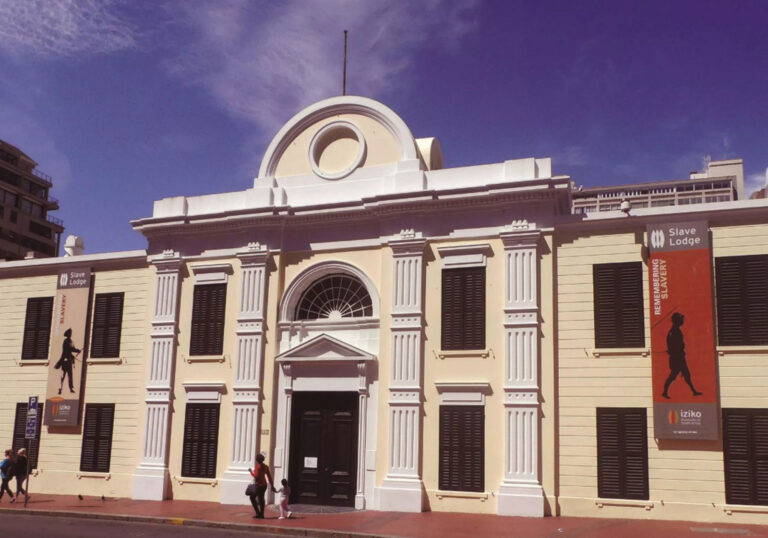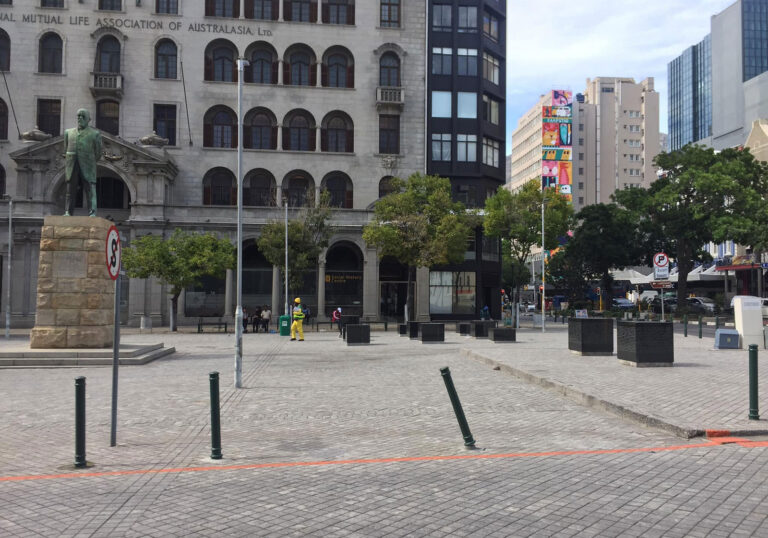
The Prestwich Memorial on Somerset Road holds the remains of people exhumed from an unmarked burial ground a few streets away, uncovered by a building development in 2003. The ground had served those excluded from Cape Town’s formal cemeteries: enslaved and formerly enslaved people, the poor, sailors and the unclaimed dead, none of them recorded by name. The decision to exhume rather than leave them where they lay was fought through public meetings and two failed appeals, and anatomical study of the human remains was refused in 2005. The memorial is the settlement that followed, and it remains contested.
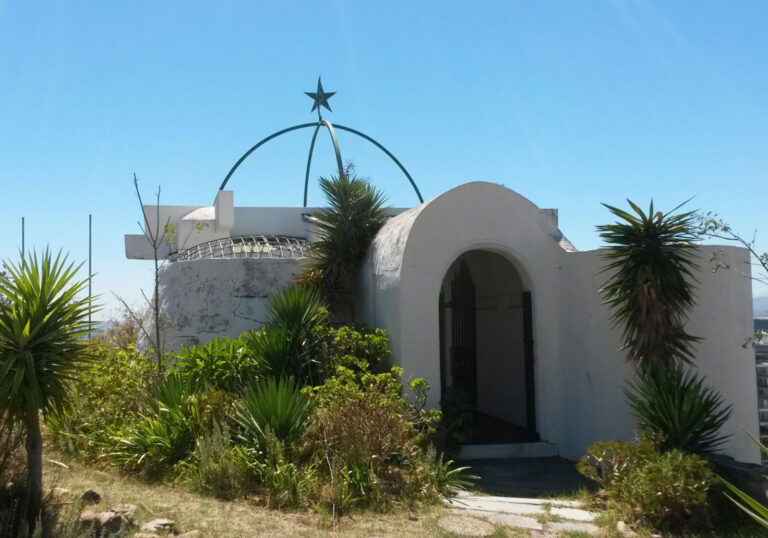
The Prestwich Memorial is a low single-storey building of brick and grey stone, standing on an awkward triangular site at the corner of Somerset Road and Buitengracht Street beside St Andrew's Square. It is easy to walk past, and the largest lettering on it belongs to the coffee roastery that occupies much of the interior, above which a smaller board names the memorial and its visitors centre. Behind that, in two dark wings that ramp down into the ground, are shelves of boxes holding human remains taken from a burial ground a few streets away. The memorial is named after Prestwich Street, where those remains were found in 2003. It does not stand on that site.
From the 1720s this edge of town was where Cape Town buried its dead. A record of 1720 refers to a burial ground for ordinary soldiers, sailors and slaves near the Lion's Rump, and over the following century a row of walled denominational cemeteries was laid out along Somerset Road, Dutch Reformed in 1755, Anglican in 1827, Scottish and Lutheran in 1833, Roman Catholic in 1840. The rule that mattered was who could be buried inside the walls. Company servants went into the enclosed ground; the enslaved were buried in the ground surrounding it. Burials here were ordered to stop in 1886.
The walled cemeteries were later emptied by law and by contract. The Lutheran ground was exhumed in 1909 and the contents of 9,400 graves reinterred at Maitland. The Dutch Reformed cemetery followed over the summer of 1920 and 1921, when some 893 coffins were moved and 132 wagon loads of memorial stones were carted away. The unenclosed ground outside the walls was never cleared. It had no markers and no register, and as the area was subdivided and sold from the 1820s it was simply built over. The archaeologists who later worked here put it plainly: almost every street north of Somerset Road has human remains underneath it.
It is often called a slave burial ground, and that is part of the truth rather than the whole of it. The archaeologists who excavated the site describe it in their own published work as an informal burial ground serving the historical Cape underclass, and the people recorded as having been buried in such ground include enslaved and formerly enslaved people, free Black people, Khoi workers, artisans, fishermen, sailors, maids and washerwomen and their children, executed criminals, people who died by suicide, paupers, and unidentified casualties of shipwrecks. The test for exclusion was not race alone but status, means and religious eligibility, so poor and unbaptised Europeans ended up here too. Cape Town's Muslim community had its own burial grounds elsewhere, on Boundary Road and above the Bo-Kaap. Not one person buried in the informal ground is documented by name.
On 16 May 2003 human remains were uncovered by site workers during the early clearance phase of a development called Prestwich Place, on the block bounded by Alfred, Prestwich, West and Schiebe Streets. Work stopped and the developer notified the South African Heritage Resources Agency, as the law requires. A rescue permit was issued in early June and archaeologists from the University of Cape Town began exhuming the site on 11 June. The apartment complex now standing there, The Rockwell, was built once they had finished.
What followed was not a simple rescue operation. By the time a public meeting was held at St Stephen's Church on 29 July, about five hundred people had already been exhumed, and the meeting was hostile enough that the heritage agency suspended work at the beginning of August. It announced on 1 September that exhumation would continue, that the remains would be reinterred elsewhere, and that there would be no memorial on the site itself. A group formed to oppose this, first as the Hands Off Prestwich Street Burial Ground Ad Hoc Committee under Father Michael Weeder and then as the Prestwich Place Project Committee. It argued that the dead should be left where they lay, that the burial ground was itself the memorial, and that the remains were ancestors rather than material for study. The heritage agency and the archaeologists argued that the ground had already been disturbed, that the law required rescue once that had happened, and that study of the remains would recover a history of people the written record had never named. The agency also held that no living descendants could be identified, which the committee rejected as a consequence of the same erasure it was protesting. Two appeals were lodged, one to the agency and one to a tribunal convened by the Minister of Arts and Culture. Both were rejected, and exhumation ran until February 2005.
The number usually attached to this story is about 2,500, and it is worth knowing what it counts. The archaeologists who dug the site published an estimate of roughly 2,500 burials, and elsewhere gave a figure of up to 3,000, which was calculated from burial density across the area rather than counted. Neither is a tally of people. A City of Cape Town audit of the ossuary in 2013 recorded 1,540 boxes of remains, and a box is not a person: some hold one individual, others hold disarticulated bone that cannot be assigned to one. The figure of 4,500 that sometimes appears is the capacity of the shelving, not its contents. The published estimate is itself a composite rather than a single tally, made up of roughly 1,272 articulated individuals, some 460 groups of remains, and further material recovered from shaft fill and general collection. No minimum number of individuals has ever been calculated for Prestwich Street.
The reason none exists turns on a distinction worth keeping straight. The burials themselves were archaeologically recorded as they were excavated, and a sample of 276 of them was later published, covering burial form, coffins, grave goods and other cultural indicators. What was refused was study of the human remains themselves. On 21 September 2005, following research applications from University of Cape Town postgraduates and a consultation process that went against them, the heritage agency declined to approve basic anatomical research on the remains exhumed from the site. That decision has not been reversed, so the only biological information on record is the non-invasive observation made in the ground during excavation, and DNA analysis is not possible. This matters for how the people themselves are described, because enslavement is a legal condition rather than a biological one and leaves no signature on a skeleton. What is known about comparable people at the Cape, including evidence of heavy physical labour and of birth far from southern Africa, comes from two nearby sites excavated in the 1990s and 2000 whose remains were studied before this dispute arose. None of it comes from Prestwich Street.
The memorial was the eventual settlement. The Minister of Arts and Culture directed the City of Cape Town to provide a permanent home for the remains, and the building, designed by the architect Lucien Le Grange, was completed in 2008 on ground that had been part of the Dutch Reformed cemetery. Parts of its walls are faced in grey Malmesbury shale, chosen to echo the old cemetery walls, and a surviving stretch of the Dutch Reformed boundary wall stands beside the entrance. Large sliding doors open on both sides so that the building can be walked through. The doorway into the ossuary itself is barely over a metre high, so that anyone entering has to bow.
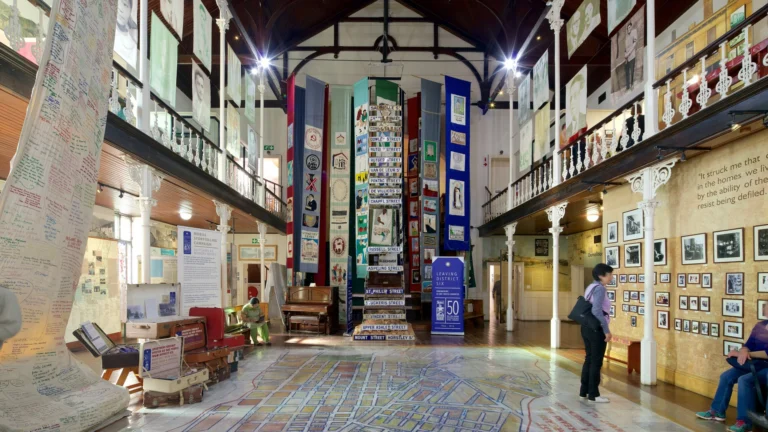
Visitors do not see human remains. The publicly accessible part is a bright interpretive room in the centre of the building, with panels on slavery at the Cape, on the neighbourhood historically known as District One, on burial practice and forced removals, and on the 2003 dispute itself. The ossuary wings on either side are dark and closed, and what is visible through the grille is shelving rather than its contents. Access to the ossuary is by appointment rather than part of an ordinary visit.
Since 2011 a coffee roastery has operated inside the building, taking up a substantial part of the floor. Its owner has said it was established to keep the memorial financially viable once no further public money was available, and that it brings people through a building most would otherwise never enter. Others have found it hard to accept. Father Michael Weeder, who led the original campaign, compared it to holding a party at a burial site, and researchers at the University of Cape Town have argued that the branding displaces the memorial's purpose and that the real problem is the absence of any management plan. The argument about what this building is for did not end when it opened.
The City of Cape Town maintains the memorial, but publishes no opening hours for it, and the times that appear on mapping and review sites are either unattributed or belong to the coffee shop. Entry is reported to be free and no admission charge is documented anywhere. There is no dedicated telephone number, website or email for the memorial, and the City has advertised a tender for upgrades to the building and its site during 2026, so anyone making a special journey should check first. The memorial is the anchor for the Emancipation Day commemorations held each year on 1 December, when the Prestwich Place Project Committee, the District Six Museum and the Institute for the Healing of Memories walk through the city at night.
Highlights
- An unmarked burial ground beneath the streets of Green Point, used until burials here were stopped in 1886
- Human remains uncovered by a building development on Prestwich Street in May 2003
- A burial ground for people excluded from the city’s formal cemeteries, not one of them recorded by name
- The campaign to leave the dead where they lay, fought through two appeals and lost
- Anatomical study of the human remains refused in 2005, so no count of individuals exists
- A memorial and ossuary of 2008, with an interpretive centre and a coffee roastery sharing the building
Tips
The memorial publishes no opening hours, and the times shown on mapping and review sites either belong to the coffee shop or are unattributed, so check before making a special trip. The publicly accessible part is the interpretive centre; the ossuary itself is seen only by appointment, and human remains are not on display. The City advertised a tender for upgrades to the building and its site in 2026, which may affect access.
Frequently Asked Questions
What is the Prestwich Memorial?
It is a memorial building on Somerset Road in Green Point containing an ossuary, a place where human remains are stored. The remains were exhumed between 2003 and 2005 from an unmarked burial ground a few streets away, after they were uncovered during work on a property development in Prestwich Street. The memorial is named after that street but does not stand on the site; it was built in 2008 on ground that had been part of the Dutch Reformed cemetery.
Who was buried at Prestwich Street?
People who could not be buried inside Cape Town’s walled denominational cemeteries. The archaeologists who excavated the site describe it as an informal burial ground serving the historical Cape underclass, and accounts of who lay in such ground include enslaved and formerly enslaved people, free Black people, Khoi workers, artisans, fishermen, sailors, domestic workers and their children, executed criminals, paupers and unidentified casualties of shipwrecks. The test was status, means and religious eligibility rather than race alone, so poor and unbaptised Europeans were buried here too. It is often called a slave burial ground, which is part of the truth rather than the whole of it. No individual buried there is documented by name.
How many people were exhumed at Prestwich Street?
There is no count, and the figures in circulation measure different things. The archaeologists published an estimate of about 2,500 burials, and elsewhere gave a figure of up to 3,000 calculated from burial density across the area rather than counted. The published estimate is itself a composite rather than a tally, made up of roughly 1,272 articulated individuals, some 460 groups of remains, and further material from shaft fill and general collection. A City of Cape Town audit of the ossuary in 2013 recorded 1,540 boxes of remains, and a box is not a person, since some hold one individual and others hold bone that cannot be assigned to one. The figure of 4,500 that sometimes appears is the capacity of the shelving rather than its contents. No minimum number of individuals has ever been calculated, because the anatomical study that would produce one was refused in 2005.
Why was the Prestwich excavation controversial?
Because of a disagreement about what should happen to the dead. After remains were found in May 2003 the heritage authority issued a rescue permit and exhumation began. A campaign formed to stop it, arguing that the dead should be left where they lay, that the burial ground was itself the memorial, and that the remains were ancestors rather than material for study. The authority and the archaeologists argued that the ground had already been disturbed, that the law required rescue once that had happened, and that study would recover a history the written record had never kept. Two appeals were lodged and both were rejected. The remains were removed, the development was built, and anatomical study of the human remains was later refused.
Can you visit the Prestwich Memorial?
The building is generally accessible during the day and entry is reported to be free, but the City of Cape Town publishes no opening hours for it and there is no dedicated telephone number, website or email. The hours shown on mapping and review sites either belong to the coffee roastery inside the building or are unattributed, so they are not reliable. The City advertised a tender for upgrades to the building and its site in 2026, so it is worth checking before making a special journey.
Are human remains visible inside the Prestwich Memorial?
No. The part open to visitors is an interpretive centre with panels on slavery at the Cape, the neighbourhood historically known as District One, burial practice, forced removals and the 2003 dispute. The remains are held in boxes on shelving in two darkened wings, behind grilles, and what is visible through them is shelving rather than its contents. Access to the ossuary itself is by appointment rather than part of an ordinary visit. There is no display of human remains.