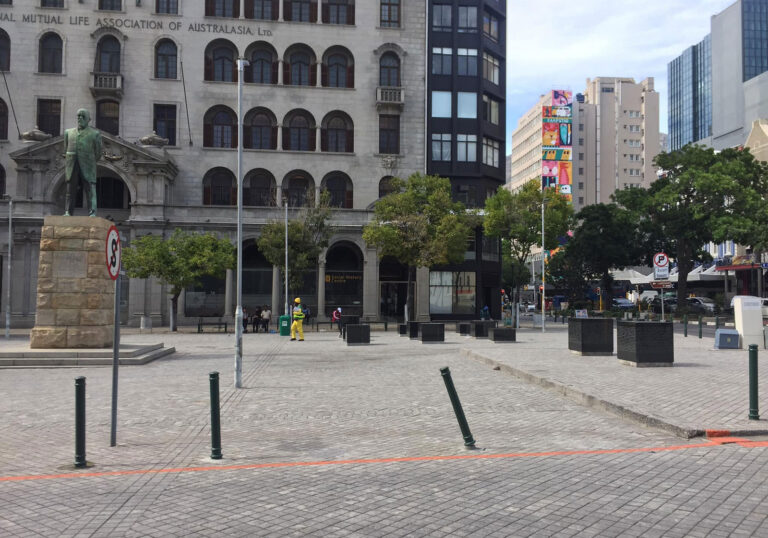
Riebeeck Square is an open block in central Cape Town that was one of the squares the town expanded around during the eighteenth century. Farmers arriving from the country outspanned their wagons here and offloaded produce, and the ground was known as the Boerenplein before it took its present name in about the 1860s. The theatre built on its Bree Street edge in 1799 survives as St Stephen’s Church. Most of the square is now a car park, and it was declared a National Monument in 1961.
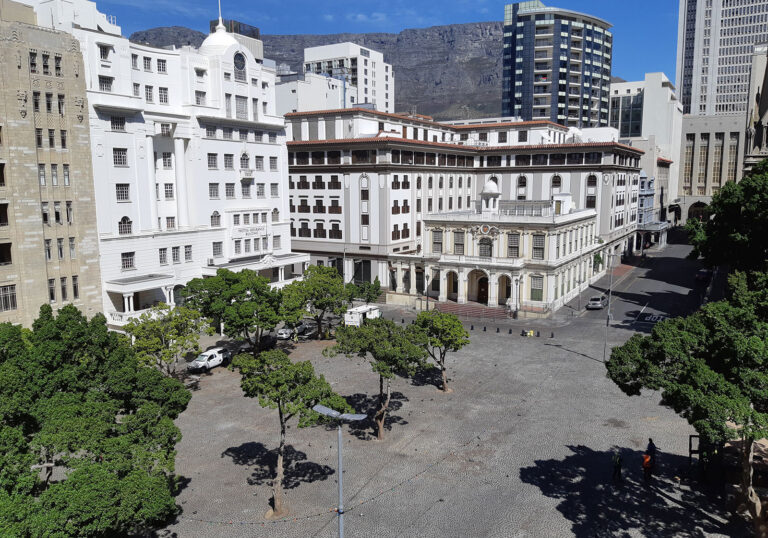
Riebeeck Square is a large open block in central Cape Town, bounded by Bree, Shortmarket, Church and Buitengracht Streets. Most of it is a surface car park: worn asphalt, faded bay markings, traffic cones and rows of parked cars, with trees along the street edges and Table Mountain filling the view. A cream classical building with tall arched windows stands on the Bree Street side. It is easy to cross the square without registering that it is anything more than somewhere to leave a car. Long before cars filled it, this was the ground where farmers arriving in Cape Town stopped their wagons.
The square took shape during the eighteenth century, as the town stopped growing only up the axis of the Heerengracht and began spreading laterally across the Table Valley. The heritage register describes it as one of the squares around which Cape Town developed, and records what it was for: here the farmers outspanned their wagons and offloaded their products. Livestock was outspanned here too. A spring was found on the ground in the late 1700s, during construction work on the square, and a well was established that served both the farmers and nearby residents, which is part of why the place worked as a stopping point. What was traded and by whom is not recorded in any detail.
The square carried several names before the current one. It was the Boerenplein, the farmers’ plain, and it also appears as Hottentot Square, a name of its period rather than ours. That name was in print by 1804, when the artist Samuel Daniell published a plate titled New Theatre, Hottentot Square in London. The name Riebeeck Square belongs to about the 1860s. Nothing in the surviving record explains why that name was chosen, although the fuller form Van Riebeeck Square, which appears in archival cataloguing, points towards the Dutch commander.
In 1799 the governor of the first British occupation, Sir George Yonge, appropriated a portion of the Boerenplein and gave a section of it to twenty-four shareholders for the building of a theatre. The African Theatre opened at the turn of the century, though accounts differ over whether the first performances took place in 1800 or 1801. That building is still standing, on the Bree Street edge, and is now St Stephen’s Church. It means that anyone crossing the square today is looking at a structure put up while the ground around it was still working as the farmers’ square. It is also the only specific, datable piece of open ground here that is known to have been built on.
After the British annexation of the Cape in 1806, a new market was opened east of the Castle in 1812, and the square’s role as the farmers’ market declined from that point. It did not empty out. The ground kept working functions into the 1820s and 1830s, when parcel carriers had stands here alongside the two other places in town where they gathered.
By the 1860s, according to the heritage record, the square had been considerably reduced in area, and it is from about that time that the name Riebeeck Square is used. What took the missing ground is not recorded. No dimensions of the earlier square survive in the published record, and no map has been identified that sets its original extent against its later one. The 1799 appropriation for the theatre is the one loss that can be dated, and the square was proclaimed a monument in 1961 partly to stop any further encroachment.
The building on the Bree Street edge has its own long history, and it is worth knowing enough of it to make sense of what you are looking at. It worked as a theatre until the mid to late 1830s, when performances tailed off amid growing opposition to the stage from parts of the town. In 1838 Dr Adamson of the Presbyterian Church proposed using it as a school for freed people, with support from the Dutch Reformed Church, and it was acquired for the congregation in March 1839 for £3,484, to serve as a church for people freed from slavery and a school for their children. Sources differ over whether the buyer was the congregation itself, the Presbyterian mission or the Dutch Reformed Church. The congregation was consecrated in 1843 and came under the control of the Dutch Reformed Church Synod in 1857. It is said to be the only Dutch Reformed church named after a saint. In 1949 a firm proposing to build a parking garage on the site made an offer ten times an earlier one, and the scheme failed because the plot proved too small and the City Council would not give up a further nine metres of Riebeeck Square.
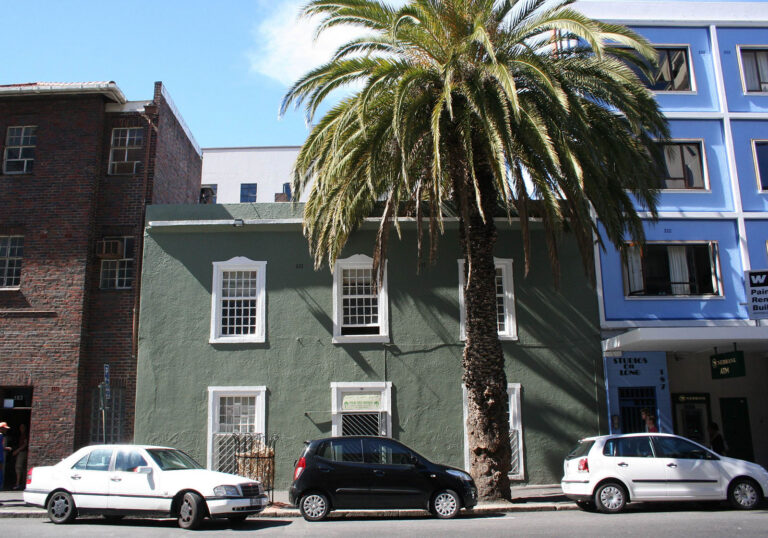
Across Shortmarket Street is Heritage Square, a block of eighteenth and nineteenth century buildings that was itself once marked for demolition, under a proposal for a ring road system that would have replaced it with a parking garage. Opposition from heritage bodies, architects and journalists saved it, and the block was restored by the Cape Town Heritage Trust in 1996 and 1997. It now holds a hotel, restaurants and a working blacksmith, and it is the clearest illustration nearby of what a restored block of this period looks like.
Riebeeck Square was declared a National Monument on 17 February 1961 and is now protected as a Provincial Heritage Site. The protection covers the whole block bounded by Shortmarket, Bree, Church and Buitengracht Streets. St Stephen’s Church is separately declared in its own right.
The square’s present condition is a matter of public record. In a 2020 Supreme Court of Appeal judgment concerning a proposed development on the far side of Buitengracht, the court noted that it was common cause that the square had deteriorated over recent decades and was now used as a parking lot. The heritage authorities involved in that case argued that the square’s character depends on its openness and on its views towards Table Mountain and Signal Hill. The land belongs to the City of Cape Town and is classified for public road and public parking. Some recent work has been done at the edges rather than on the square itself: the electrical substation on the Bree Street side was painted with murals and given seating and planters in 2025. The square also appears in the City’s draft framework for the central business district among the public squares proposed for upgrading.
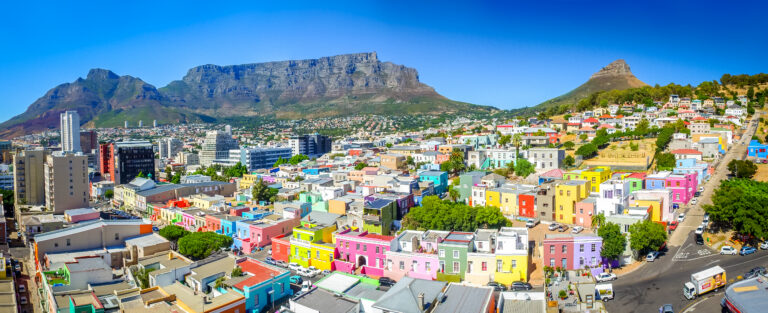
There is no entrance and nothing to book. What the square offers is the chance to stand in a piece of open ground that the city grew around, work out its scale, look across at a theatre that became a church, and see how the block relates to Heritage Square and to Bo-Kaap rising behind Buitengracht. It rewards ten or twenty minutes on the way between Bree Street, Greenmarket Square and the Bo-Kaap rather than a journey made for its own sake.
Highlights
- An eighteenth-century outspan where farmers arriving in Cape Town stopped their wagons and offloaded produce
- One of the open squares around which Cape Town expanded across the Table Valley
- Known as the Boerenplein, and in print as Hottentot Square by 1804
- St Stephen’s Church on the Bree Street edge began as a theatre, built from 1799 on ground taken from the square
- A new market east of the Castle in 1812 drew the farmers’ trade away
- A Provincial Heritage Site, declared a National Monument on 17 February 1961
Tips
Stand on the Church Street or Shortmarket Street side to take in the full width of the block and the view towards Table Mountain, which is the aspect the heritage authorities regard as central to the square’s character. St Stephen’s Church is not generally open to casual visitors, so treat it as a building to look at from the square. Combine the stop with Heritage Square across Shortmarket Street and with Greenmarket Square a few blocks east.
Frequently Asked Questions
What is Riebeeck Square known for?
It is one of the open squares around which Cape Town expanded during the eighteenth century, when the town began spreading laterally across the Table Valley rather than only up the line of the Heerengracht. Farmers coming into town outspanned their wagons and livestock here and offloaded their produce, and a well on the ground served both them and nearby residents. The square is also known for the building on its Bree Street edge, which began as a theatre in 1799 and is now St Stephen’s Church.
Why is it called Riebeeck Square?
The name came into use from about the 1860s, replacing the earlier Boerenplein and Hottentot Square. Nothing in the surviving record explains why it was chosen. The fuller form Van Riebeeck Square appears in archival cataloguing and points towards Jan van Riebeeck, the commander of the first Dutch settlement at the Cape, but no source documents the decision.
What was the Boerenplein?
Boerenplein, the farmers’ plain, is the earlier name for this same ground. It describes what the square was used for: the point on the western edge of the growing town where farmers arriving from the country were allowed to outspan their wagons, rest their livestock and offload produce. The name was still in use in 1799, when part of the ground was taken for the theatre that became St Stephen’s Church.
What is the old building on Riebeeck Square?
St Stephen’s Church, on the Bree Street edge. It was built as the African Theatre, the first theatre in Cape Town, after Governor Sir George Yonge appropriated part of the Boerenplein in 1799 and passed a section of it to twenty-four shareholders. It worked as a theatre until the mid to late 1830s, was acquired for a congregation in March 1839 to serve people freed from slavery, and came under the Dutch Reformed Church Synod in 1857. It is separately protected as a Provincial Heritage Site in its own right.
Is Riebeeck Square still a market?
No. A new market was opened east of the Castle in 1812 and the square’s role as the farmers’ market declined from that point, though the ground kept working uses into the 1820s and 1830s, when parcel carriers had stands here. No market operates on the square today, and most of it is a car park. The nearest historic market square still in use is Greenmarket Square, a few blocks east.
Is Riebeeck Square worth visiting?
It is worth ten or twenty minutes as part of a walk through the old city rather than a trip made for its own sake. There is no entrance, nothing to book and little to see in the conventional sense: the interest is in standing on a piece of ground the city grew around, seeing its scale, and looking across at a theatre that became a church. It sits well between Bree Street, Heritage Square, Greenmarket Square and the Bo-Kaap.