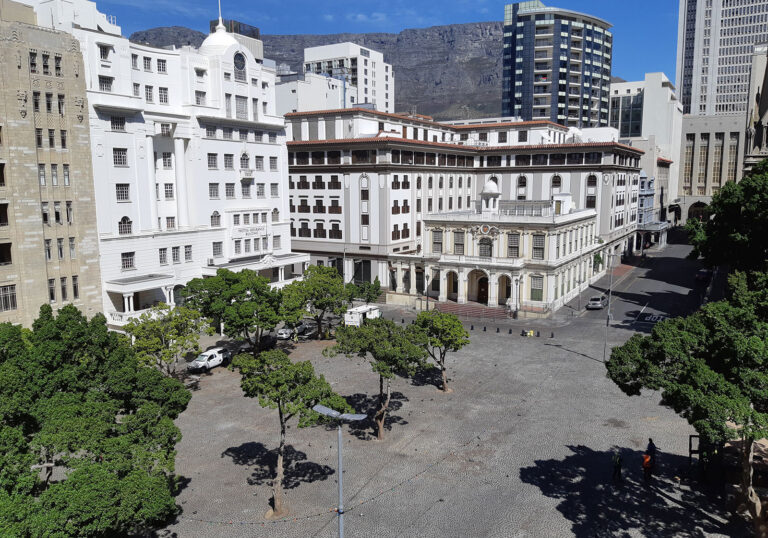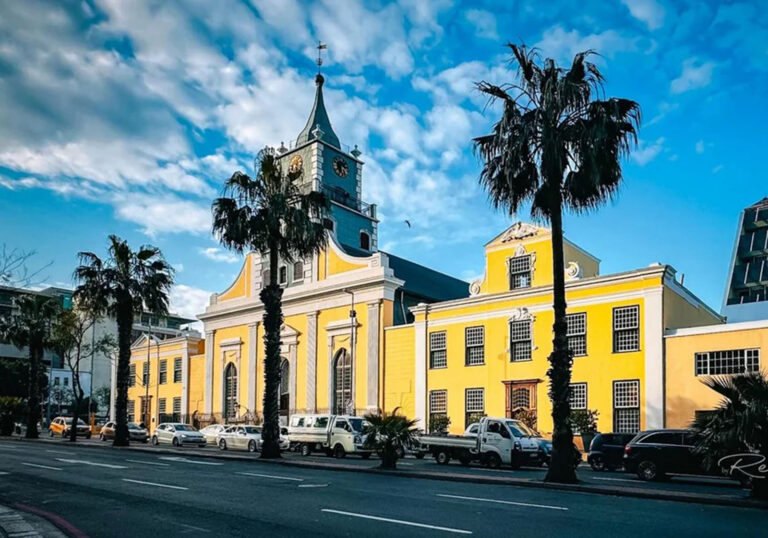
Heritage Square is not a square but a city block, bounded by Bree, Shortmarket, Hout and Buitengracht Streets, holding what the Cape Town Heritage Trust calls the largest surviving group of eighteenth-century buildings in Cape Town. The whole block was to have been demolished for a parking garage under a ring road scheme. It was saved, donated to the Trust in 1996 and restored by 1998, deliberately keeping the evidence of two centuries of alteration rather than restoring to one invented date. It now works as a hotel, restaurants and shops around a courtyard with an old grapevine.
Heritage Square is easy to misread. The name suggests an open public square, and it sits directly across Shortmarket Street from one, but it is not a square at all. It is a city block, bounded by Bree, Shortmarket, Hout and Buitengracht Streets, made up of old buildings that were restored in the 1990s and turned back into working premises. There is a signed entrance on Bree Street leading through to an internal courtyard with an old grapevine over it, and around that courtyard are a hotel, restaurants, bars and shops. What a visitor is walking into is a block of the eighteenth-century town that Cape Town very nearly demolished.
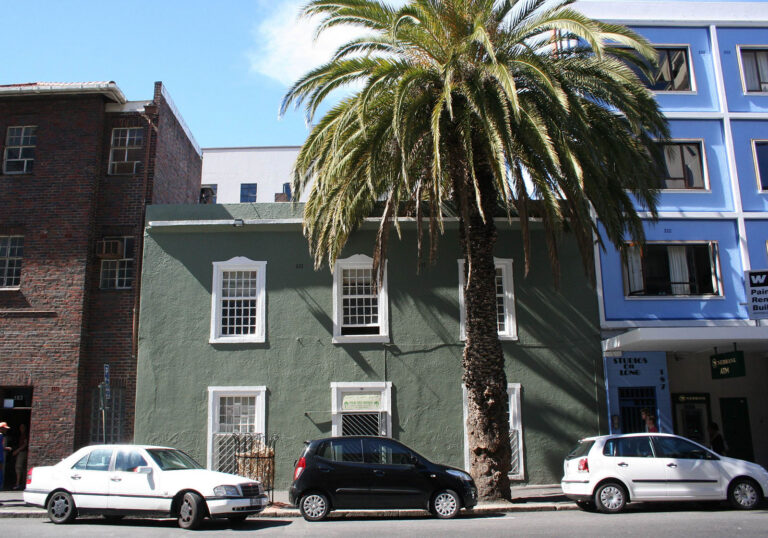
The buildings are usually described as eighteenth century, and the Cape Town Heritage Trust calls this the largest surviving group of such buildings in the city. Precise dates are harder than the marketing suggests. A construction date of 1771 circulates widely, but it traces to a claimed land grant rather than to any building record, and a grant dates the plot rather than what stands on it. The block is not uniformly old either: one of its buildings was put up by the Docks Warehouse Company in 1902. What the Trust describes is a group of town houses with their outbuildings and a warehouse, altered repeatedly, giving the block a character it dates to the early nineteenth century.
That layering is the point rather than a flaw. These were working buildings that were changed as their owners and uses changed, and the restoration set out to keep the evidence of those changes rather than strip them back to a single chosen year. The Trust’s account describes handling each building so as to retain as many elements of its successive alterations as possible, producing what it calls an eclectic mix. Nobody reconstructed a fake 1780 streetscape here.
The block survived by a narrow margin. It stood in the path of an extensive ring road scheme for the city, including a proposed Buitengracht Freeway, which would have taken the whole Bree and Shortmarket block for a parking garage along with other old buildings on Hout and Shortmarket Streets. Published accounts disagree about when this was proposed and fought, placing it anywhere from the 1960s to the 1990s. What is consistent is who resisted it: the Simon van der Stel Foundation and the Institute of Architects led the opposition, with support from the city councillor Joan Kantey and from journalists including Victor Holloway.
The Cape Town Heritage Trust was established in 1987 by the City Council with backing from the provincial administration. The council-owned properties on this block were donated to it in 1996, and the restoration was finished in the middle of 1998. It became the Trust’s largest project. The conservation architects were David van den Heever, of GAPP, and Trevor Thorold, with Hennie Fagan as structural engineer, Resnekov and Nielsen as builders and Tony Davenport as project manager.
Before the main contract began the team spent six weeks investigating the buildings, and the Trust records that this turned up things nobody knew were there. An eighteenth-century door was found bricked up on both sides, still carrying its original lock and handles. Archaeological excavation was carried out, and scraping exposed historic decoration on the walls. The value of doing that work first was that the design could be settled with the discoveries already known rather than running into them halfway through.
The principal building, 90 Bree Street, had come closest to being lost. Decades of neglect had reduced it to little more than a shell, and by the Trust’s account it survived only because a temporary roof was put over it during the 1980s. It is now the Cape Heritage Hotel.
In its courtyard is a grapevine that the Cape Town Heritage Trust describes as the oldest surviving grapevine in South Africa, estimated to have been planted in the 1770s. The estimate is worth taking as an estimate: other accounts give 1771 or 1781, sources disagree over whether it is Chenin Blanc or Crouchen Blanc, and no dating evidence has ever been published for any of the figures. Other old vines carry similar claims, including one in the Company’s Garden. What is documented is more recent and more interesting. The vine developed Eutypa dieback, a disease that attacks the wood, and was treated and rehabilitated, its tendrils secured and a new support structure built so that it could spread further across the courtyard. Cuttings were taken and planted in the Company’s Garden in 2020. Small quantities of wine have been made from its fruit, sold at auction to fund its upkeep.
The Trust also records that its joint venture with the businessman Sam Montsi made Heritage Square the first post-apartheid inner-city development in Cape Town involving a Black developer. That account comes from the Trust itself and has not been independently corroborated. Montsi’s career is well documented otherwise: he was the first Black general manager in the South African Breweries group, and went on to build interests in fishing, shipbuilding, property and mining.
The precinct is busy and has stayed that way. Tenants have turned over considerably, as they do anywhere, but the hotel is operating and the restaurants, bars and shops around the courtyard are trading. There is no admission charge, no ticket office and no visiting hours, because Heritage Square is not run as an attraction. Nobody publishes access arrangements for the precinct as a whole, and no guided tours of it are offered. In practice a visitor walks in from Bree Street, looks at the courtyard and the vine, and either sits down at one of the businesses or does not.
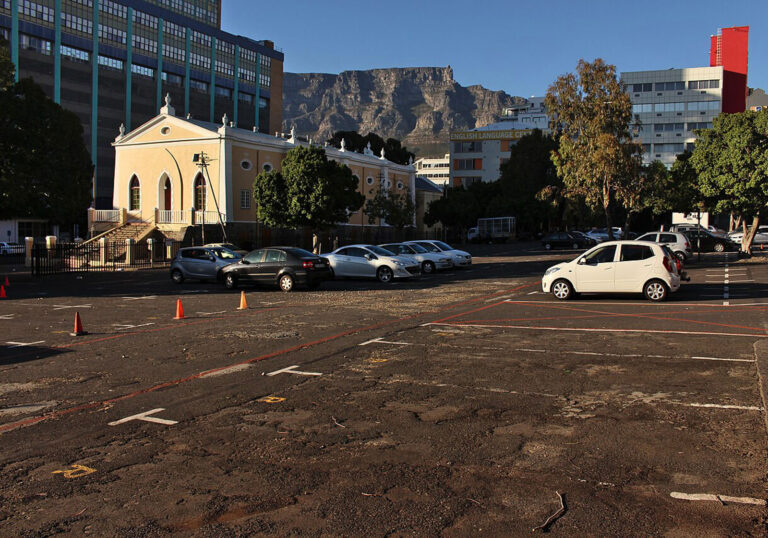
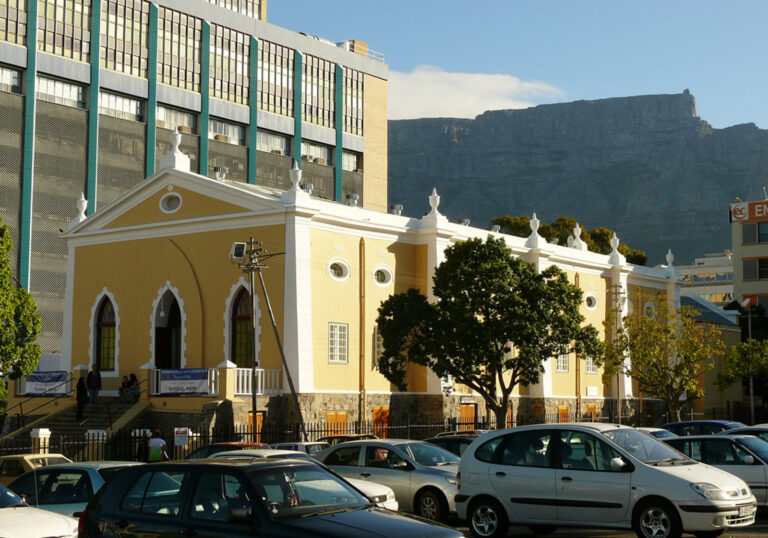
The relationship with Riebeeck Square across Shortmarket Street is worth understanding, because the two are constantly confused. Riebeeck Square is the open square on the uphill side, a former farmers’ outspan now largely used for parking, with St Stephen’s Church on its Bree Street edge. Heritage Square is the built block on the seaward side. They are neighbours with a shared history of nearly being cleared for traffic, and the practical link between them today is that Heritage Square directs its visitors to park in Riebeeck Square.
The argument the Trust set out to make here was that conservation and commercial development are not mutually exclusive, and that a historic block could pay for itself rather than being emptied out and preserved as an exhibit. Three decades on, that is what the place demonstrates. Heritage Square survives not because it was sealed off from the working city, but because it was put back into it.
Highlights
- A surviving group of eighteenth-century town houses, outbuildings and a warehouse, not a public square
- The whole block was to be demolished for a parking garage under a proposed ring road scheme
- Donated to the Cape Town Heritage Trust in 1996 and restored by the middle of 1998
- Conservation that kept elements of successive alterations rather than restoring to a single date
- A courtyard grapevine the Trust estimates was planted in the 1770s
- Historic buildings still in everyday commercial use rather than preserved as exhibits
Tips
Go in rather than walking past: the courtyard and the vine are behind the Bree Street frontage and are not visible from the street. Signage is poor and visitors regularly report difficulty finding the entrance, so look for the Heritage Square sign on Bree Street rather than the hotel name. Nothing about precinct access is published, and the businesses inside keep their own hours, so an early evening visit will find more open than an early morning one.
Frequently Asked Questions
What is Heritage Square in Cape Town?
It is a restored block of historic buildings, not a public square. It occupies the block bounded by Bree, Shortmarket, Hout and Buitengracht Streets, and the Cape Town Heritage Trust describes it as the largest surviving group of eighteenth-century buildings in Cape Town. Behind the Bree Street frontage is an internal courtyard with an old grapevine, and the buildings around it hold a hotel, restaurants, bars and shops. It was restored in the 1990s and is used as ordinary commercial premises rather than run as a visitor attraction.
Is Heritage Square the same as Riebeeck Square?
No, and the two are constantly confused. They are separate blocks facing each other across Shortmarket Street. Riebeeck Square is the open square on the uphill side, a former farmers’ outspan now used largely for parking, with St Stephen’s Church on its Bree Street edge. Heritage Square is the built-up block on the seaward side, a group of restored buildings around a courtyard. The practical link is that Heritage Square directs its visitors to park in Riebeeck Square.
How old are the buildings at Heritage Square?
The block is generally described as eighteenth century, but it does not have one construction date and the precise dates are less settled than they are often made to sound. A date of 1771 circulates widely; it traces to a claimed land grant rather than to a building record, and a land grant dates the plot rather than the structure on it. The block also includes a building put up in 1902. What the Trust describes is a group of town houses, outbuildings and a warehouse, altered repeatedly over two centuries.
Was Heritage Square nearly demolished?
Yes. The whole block stood in the path of an extensive ring road scheme for the city, including a proposed Buitengracht Freeway, and was to be cleared for a parking garage along with other old buildings on Hout and Shortmarket Streets. Published accounts disagree about the decade, placing the proposal anywhere between the 1960s and the 1990s. The opposition came from the Simon van der Stel Foundation and the Institute of Architects, with support from the city councillor Joan Kantey and from journalists including Victor Holloway. The council-owned properties were eventually donated to the Cape Town Heritage Trust in 1996 and restored by 1998.
What is special about the grapevine at Heritage Square?
The Cape Town Heritage Trust describes it as the oldest surviving grapevine in South Africa and estimates that it was planted in the 1770s. That is an estimate rather than a documented date: other accounts give 1771 or 1781, sources disagree over whether it is Chenin Blanc or Crouchen Blanc, and no dating evidence has been published. Other old vines carry similar claims, including one in the Company’s Garden. The vine developed Eutypa dieback, was treated and given a new support structure, and cuttings from it were planted in the Company’s Garden in 2020. Small quantities of wine have been made from its fruit.
Can you visit Heritage Square?
Yes, in the sense that it is a working city block you can walk into from Bree Street, and there is no admission charge or ticket office. But no opening hours or access arrangements are published for the precinct as a whole, and no guided tours of it are offered. The businesses inside keep their own hours and their interiors are theirs rather than public space. Visitors regularly report that the entrance is hard to find, so look for the Heritage Square sign on Bree Street.