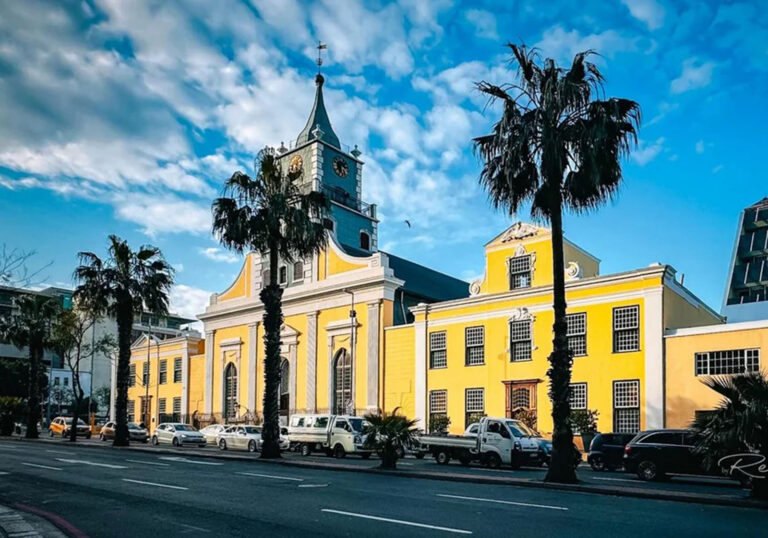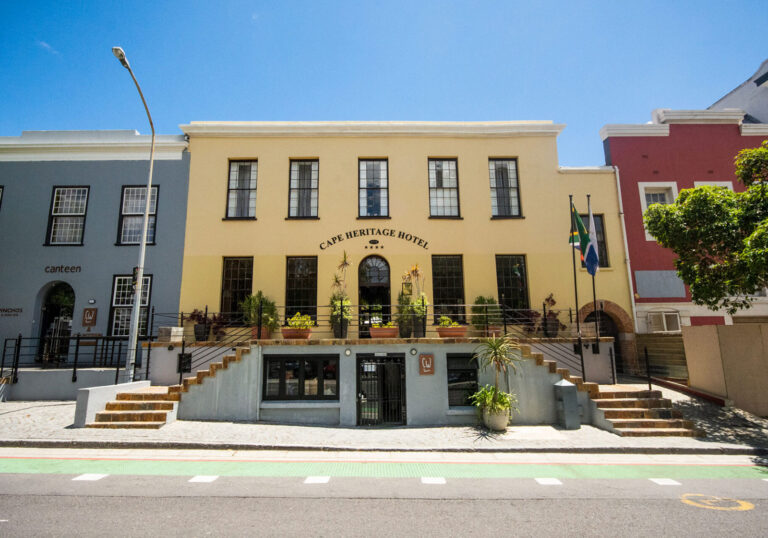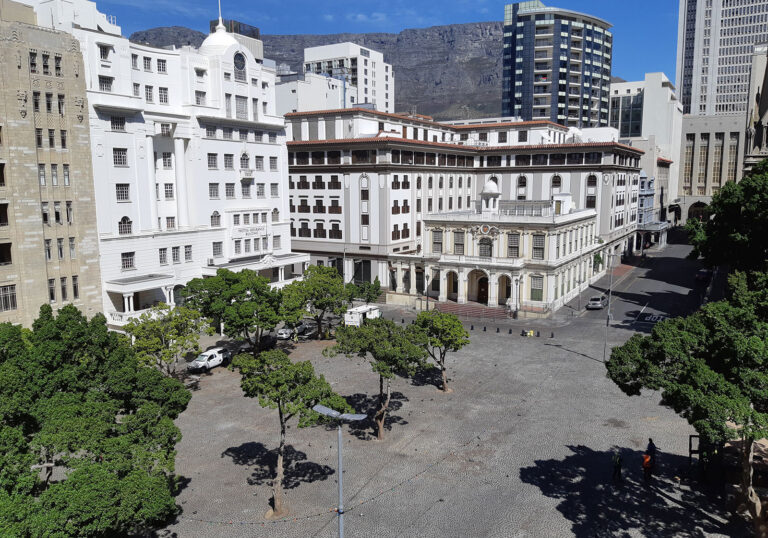
Martin Melck House at 96 Strand Street was built in the early 1780s as the parsonage of the Lutheran congregation next door, on ground given by Martin Melck, who died in the year building began and never lived here. Above its carved teak door sits a dakkamer, a small gabled room on the roof that SAHRA’s 2013 gazette called the last of its kind in Cape Town. With the church and the Sexton’s House it forms a block declared a National Heritage Site in 2017. The house itself is seen from the street rather than entered.
The building at 96 Strand Street is a two storey eighteenth century townhouse with a small room set on its roof, framed by scrolled volutes and crowned with a carved bird. Its name, Martin Melck House, leads most visitors to assume that Martin Melck lived here. He did not. Melck gave the Lutheran congregation the ground beside its Strand Street church, and he died in February 1781, at about the time building work began. What went up on the plot was the Lutheran minister’s residence, and the name the building now carries was attached to it only in the twentieth century.
Martin Melck was born at Memel in East Prussia in 1723 and reached the Cape as a Company soldier in 1746. He married into land, acquired Elsenburg in 1752 and went on to hold a string of farms across the western Cape. Those farms were worked by enslaved people: the City of Cape Town’s Slave Heritage Walks record 204 across the eleven properties he owned and farmed. He was also the most important lay figure in Cape Town’s Lutheran community at a time when the Dutch East India Company permitted no public worship other than Dutch Reformed. In 1774 he made over to the Lutherans a Strand Street building he had put up as a warehouse, and they used it quietly until permission for a Lutheran congregation was granted in 1779. Beside it he set aside a plot for a manse.
Building on the manse plot began in 1781, the year Melck died, and the parsonage was finished in the early 1780s. Sources give 1781, 1782 and 1783, and no datestone or building record settles the question, so the early 1780s is as close as the evidence allows. Tourist literature routinely credits the design to Louis Michel Thibault, but Thibault did not reach the Cape until 1783 and his earliest documented Cape work comes later still. Anton Anreith, who carved the pulpit in the church next door, was at the Cape from 1777 and is traditionally associated with the carved entrance and the ornament of the front, though that association rests on tradition rather than on a contract or a payment record.
The feature to look for is the dakkamer, the small room standing above the main roofline at the centre of the front. A dakkamer is a Cape townhouse device: a room built on the flat roof, given its own windows and wrapped in a decorative gable so that it reads as part of the façade. Writers have explained it as a lookout over Table Bay for incoming ships and as housing for the gear used to hoist goods to the upper floors, and both explanations are still in circulation. When SAHRA gazetted the block in 2013 it called Martin Melck House the last remaining dakkamer style town house in Cape Town. Below the roof room the front door is a carved teak portal with a leaded fanlight, set between panelled pilasters, and the middle windows carry moulded architraves.
The house is one of three eighteenth century buildings standing in a row. Martin Melck House is at 96 Strand Street, the Lutheran church at 98, and the Sexton’s House, or Kostershuis, at 100 on the Buitengracht corner. They were put up for one institution over roughly the same period and they read as one group, which is why the modern heritage listing treats them together. Behind them the block runs through to Bree Street, where a separate warehouse long associated with the Melck name has been redeveloped into apartments above its retained eighteenth century shell.
The house served as the Lutheran parsonage until 1891. No surviving account explains what ended the arrangement, and the congregation’s own history passes over it. From 1894 the church let the building out and it became known as Bloemfontein House. Accounts differ over whether it was a private dwelling or a boarding house, and nothing explains where the name came from. For the next several decades it was ordinary rented property rather than a monument, and it is described in later writing only as having had a chequered career.
In 1929 a group of Cape Town clubs and societies, concerned for the building’s future, formed a company and took over the lease. A restoration followed in the early 1930s, and Lady Florence Phillips, who was active in Cape heritage causes in those years, is credited with a hand in it. It was around this period that the building acquired the name Martin Melck House, which was in use by the time of its proclamation as a monument. The name is a twentieth century commemoration of the man who gave the ground, not a record of anyone who lived here.
Martin Melck House was declared a National Monument on 3 July 1936, and the church and the Sexton’s House followed in the late 1940s. Under the National Heritage Resources Act of 1999 declarations of that kind became provincial heritage sites. In March 2013 SAHRA provisionally protected the whole block as a potential national heritage resource, describing it as the only remaining VOC era urban ensemble of private, public and utilitarian buildings dating to the eighteenth century. A second provisional protection followed, and on 29 September 2017 SAHRA declared the Evangelical Lutheran Church Complex on Erf 9245, comprising the church, the parson’s house, the Sexton’s House and the enclosed courtyards of the block, a National Heritage Site. That is the highest level of protection in South African heritage law.
From 2000 the congregation leased the house out, and from 2001 it was open to the public as the Gold of Africa Museum, showing the Barbier-Mueller collection of West African gold that AngloGold Ashanti had bought the year before. A restaurant ran in the cellar until it moved to Green Point at the end of 2012. The museum wound down in the middle of the decade, a travelling Nelson Mandela exhibition occupied the building in 2016 and 2017, and the lease ended on 31 December 2017. The gold collection is now held at the Javett Art Centre at the University of Pretoria, and in November 2024 twenty eight Asante pieces from it were returned to the Asantehene in Ghana.
A good deal of Cape Town visitor information still carries the museum’s old opening hours, entrance fee and telephone number. None of it applies. The house has had no public visitor operation since the lease ended, and it went through a seven phase programme of repairs in 2018 under a heritage agreement with SAHRA, including sash window refurbishment and replastering of the enclosed rear courtyard in lime mortar to conservation specification.
There is no established public access to the inside of the house. It has no ticket office, no published hours and no tour that goes indoors, and the dakkamer cannot be visited. The outside is a different matter, and it is the point of the stop: the façade, the carved door and the roof room above it are read from the pavement on Strand Street. The church next door is the exception: it holds a service at ten on Sunday mornings, and visitors who come to the door are often shown the interior, including Anreith’s pulpit. The Sexton’s House at the far end of the row is the Netherlands Consulate General, entered by appointment on consular business only.
What Strand Street offers is a façade and a block. That is less than a museum and more than it sounds. Very little eighteenth century Cape Town survives in its original setting, and almost none of it survives as a complete group of buildings raised by one institution for one purpose. The parsonage, the church and the sexton’s house still stand in the order they were built, in a street that has otherwise been rebuilt around them, and the roof room above the carved door is the reason heritage authorities singled this house out from the rest of the block.
Highlights
- Built in the early 1780s as the parsonage of the Strand Street Lutheran congregation
- Named after Martin Melck, who gave the ground and died before the house was finished
- A dakkamer, or roof room, that SAHRA’s 2013 gazette called the last of its kind in Cape Town
- A carved teak entrance and leaded fanlight traditionally attributed to Anton Anreith
- The minister’s residence until 1891, then let out for decades as Bloemfontein House
- Part of the Lutheran complex declared a National Heritage Site in 2017
Tips
Look up. The dakkamer is the whole point of the building and it is easy to walk straight past it at street level. Stand back across Strand Street to see the roof room against the sky, then come close for the carved door and the fanlight. Read the three buildings as a row rather than as one house.
Frequently Asked Questions
Did Martin Melck live in Martin Melck House?
No. Martin Melck gave the Lutheran congregation the ground beside its Strand Street church for a manse, and he died in February 1781, at about the time building work began. The house was built as the Lutheran minister’s residence and served as the parsonage until 1891. The name Martin Melck House was attached to the building in the twentieth century, long after his death, which is why it is often mistaken for his home.
When was Martin Melck House built?
In the early 1780s. Building began in 1781 and different sources give 1781, 1782 and 1783 as the date of the house. There is no datestone and no surviving building record that settles it, so the early 1780s is the honest answer. The most commonly repeated dates all trace back to a single twentieth century reference work rather than to independent evidence.
What is a dakkamer?
A dakkamer is a small room built on the flat roof of a Cape townhouse, usually at the centre of the front and wrapped in its own decorative gable so that it forms part of the façade. At Martin Melck House it sits above the entrance, framed by large scrolls and topped by a pediment with a carved bird. Writers have explained the dakkamer as a lookout over Table Bay for approaching ships and as a housing for the gear used to hoist goods to the upper floors. When SAHRA gazetted the block in 2013 it described this one as the last remaining dakkamer style town house in Cape Town.
Was Martin Melck House the Gold of Africa Museum?
Yes, but not any longer. The congregation leased the house from 2000 and the Gold of Africa Museum opened there in 2001, showing a collection of West African gold. The museum wound down in the middle of the 2010s, a travelling Nelson Mandela exhibition used the building in 2016 and 2017, and the lease ended on 31 December 2017. The gold collection is now at the Javett Art Centre at the University of Pretoria. A good deal of Cape Town visitor information still lists the museum’s old hours, fee and telephone number, and none of it applies.
Can you visit Martin Melck House today?
You can see it, but you cannot go inside. There is no ticket office, no published opening hours and no tour that enters the building, and the dakkamer is not accessible. The house is viewed from the pavement on Strand Street, where the façade, the carved door and the roof room above it are all clearly visible. The Lutheran church immediately alongside is the part of the complex that can be entered: it holds a service at ten on Sunday mornings and visitors who come to the door are often shown the interior.
Is Martin Melck House part of the Lutheran Church?
It is part of the same historic complex. Martin Melck House at 96 Strand Street was the parsonage, the Lutheran church stands alongside at 98, and the Sexton’s House, or Kostershuis, is on the Buitengracht corner at 100 and now houses the Netherlands Consulate General. In September 2017 SAHRA declared the three buildings and the enclosed courtyards of the block, on Erf 9245, a National Heritage Site.