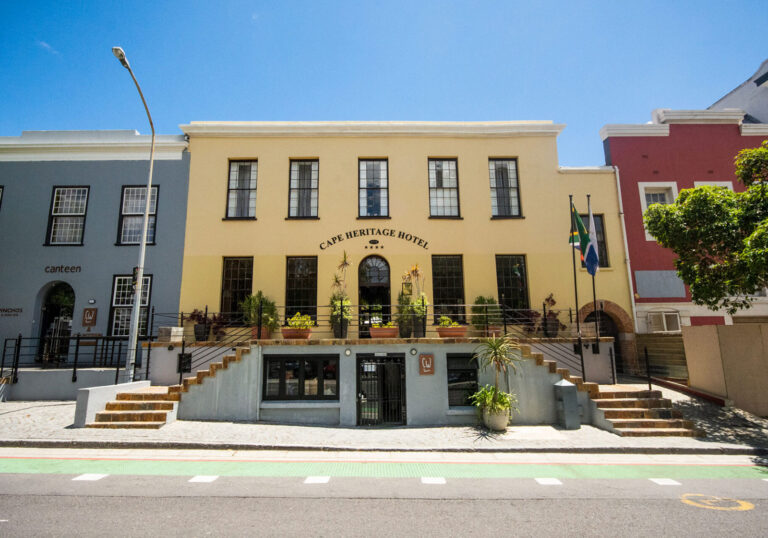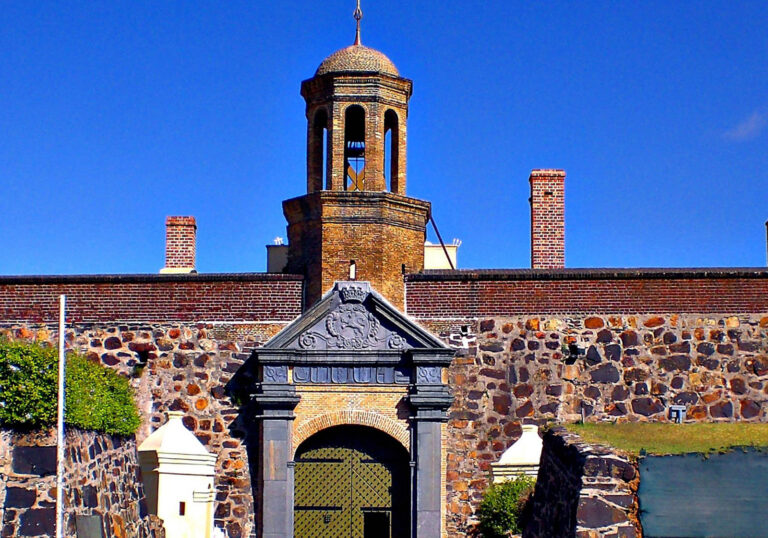
Koopmans-de Wet House at 35 Strand Street is a Cape Town townhouse whose site was first built on in 1699 and which was given its present Neoclassical front in the 1790s. It was the De Wet family home from 1806, and Iziko Museums records by name the enslaved people held by that household. It opened in 1914 as what Iziko calls South Africa’s oldest house museum, named for Marie Koopmans-de Wet. The museum is currently closed to visitors while conservation work is underway, and the historic building can still be seen from Strand Street.
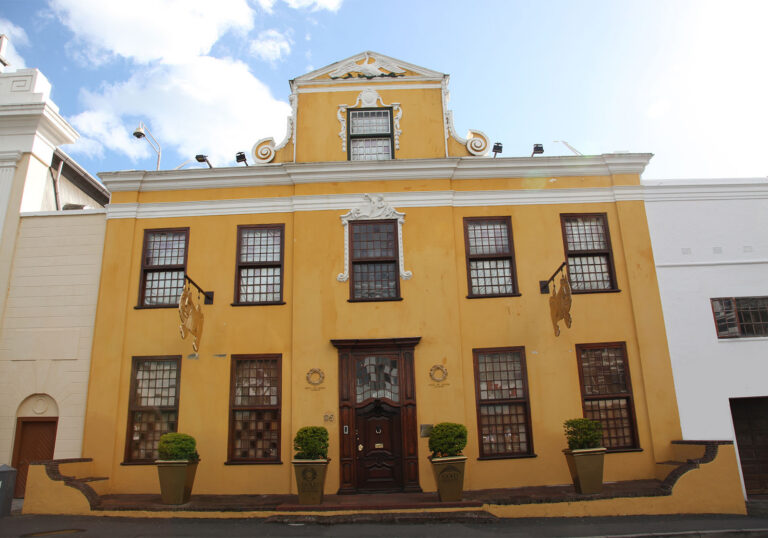
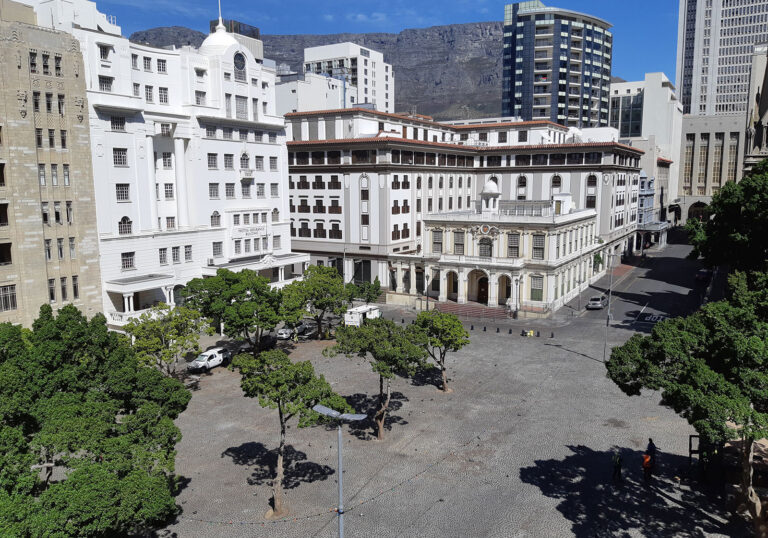
Koopmans-de Wet House stands at 35 Strand Street, a two storey townhouse with four fluted pilasters across its front, pressed on every side by the taller buildings of the modern city. It is a museum, and it is currently closed. Iziko Museums began conservation work here in 2025, the furniture and objects have been taken out of the house, and no reopening date has been published. What a visitor can still see is the outside, which is a large part of why the building matters.
The site goes back almost to the beginning of Dutch Cape Town. Iziko records that the first grantee, Reynier Smedinga, a silver assayer from Friesland, began building a dwelling here in 1699. The property changed hands several times before Johann Böttiger bought it in 1748 and enlarged it over the next two decades, and Pieter Malet of Amsterdam bought it from him in 1771. By then the old low houses of the neighbourhood were disappearing and Strand Street was being rebuilt in the town fashion of symmetrical, double storey, flat roofed houses.
By the 1790s the house had become too small for the Malet household. Malet rebuilt rather than replaced. He kept the old walls, put an entirely new front on the street side, carried a second storey across the whole width, and bought portions of the neighbouring properties so that a carriage house could have its own entrance. What stands on Strand Street today is that decision: an old house given a new face for the public side.
That face is why the building appears in every account of Cape architecture. Four fluted pilasters run up the front, some of them wood and some plaster. The pediment spans three windows instead of the usual one. A carved frieze runs above the door, plaster garlands fill the panels between the two rows of windows, and the full width of the building is fronted by a raised stoep of klinkers, hard burnt bricks brought from Holland, closing with a plastered brick seat at each end. A lantern hangs in the fanlight above the door, and a candle was lit in it every evening as soon as it grew dark.
Iziko dates the front to possibly 1790 and states that there is no documentary evidence as to who designed it. Historians have attributed the work to Louis Thibault, who was at the Cape from 1783, and to the sculptor Anton Anreith, and a 1988 study of the proportions of the façade called the Thibault attribution unfounded. No document names a designer.
Hendrik Vos bought the house from Malet’s widow in 1796 and his family lived here for ten years. In 1806 it was bought by Margaretha Jacoba de Wet, born Smuts, a young and wealthy widow looking for a house in which to raise her family. She held it until her death in 1840, and her descendants kept it for the rest of the century. The name the house carries today is that of her granddaughter.
Her late husband, Hendrick Justinus de Wet, had been President of the Burgher Council during the first British occupation, and he had held twenty six enslaved people. His will gave his widow the first choice of them, allowed his adult children to choose from the remainder, and stipulated that enslaved families in his possession should not be separated. She chose seven. That choice was made before she bought the Strand Street house, so these were people who came into it with the household rather than people the house had always held.
Iziko names them. Jonas van de Caab was a cooper, Citie is recorded as his wife in a union the church would not marry, and Hector and Jacob were their children. Kito van Mosambique was a cook and July a houseboy. By 1816, when ten enslaved people were registered to the widow, July no longer appears and four names are new: Lafleur and Lendor, both woodcutters, Kado, also called Bejoen and then about thirty, a tailor, and Nancy, who was about four years old. Jonas and Kado were hired out to work elsewhere, which brought income into the household. Lendor died on 31 December 1822. Nancy was still recorded in 1829, by then with three daughters, one of whom, Malatie, died at about a year old, and the record names no father. Slavery at the Cape was abolished in 1834, within this family’s ownership of the house.
These are two groups about fourteen years apart rather than one household standing together, and beyond a name, a trade and occasionally a date the record thins very quickly. Where the enslaved members of the household slept is not settled. The upper floor of the courtyard outbuildings is often said to have housed them, and Iziko states that there is no definite evidence of it. What is not in doubt is the dependence. A house on this scale could not have been run without them, and the elegance of the front cannot be separated from the labour behind it.
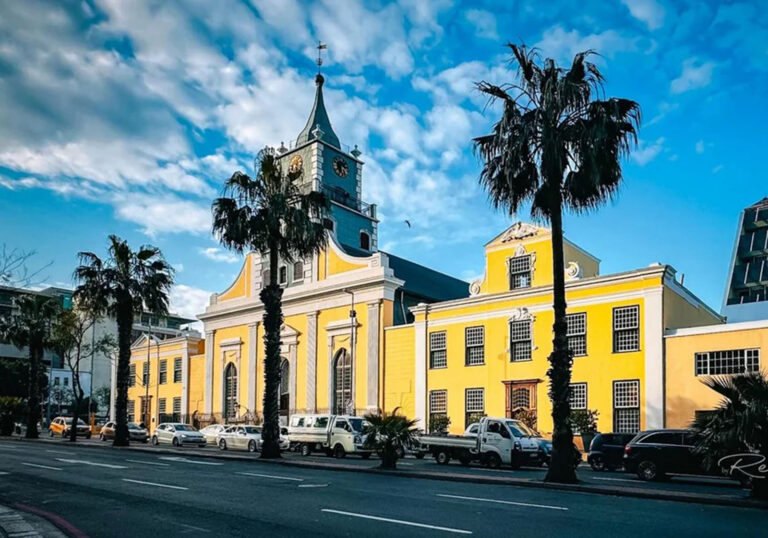
Maria Margaretha de Wet was born in 1834 and married Johan Christoffel Koopmans in 1864. After his death in 1879 she took the compound surname the house now carries. Through her mother, Adriana Horak, she was a great-granddaughter of Martin Melck, the Lutheran landowner whose donated warehouse became the Strand Street Lutheran Church a few minutes further along the same street. Iziko identifies a brass chandelier in the lower hall of the house, dated about 1780 and bearing the name Martinus Lourens Smith, as one of a set made for that church. The two buildings stand at opposite ends of one family story.
The house became known as the Salon of Strand Street, where she received and entertained the colony’s public figures. She campaigned against the partial demolition of the Castle of Good Hope in the 1880s, and in 1905 she was a founding member of the South African National Society, which was formed in Cape Town with the threat to the Castle as its immediate cause. Iziko also credits her with preventing unsympathetic alterations at Groot Constantia and with helping to stop the closure of a Muslim cemetery at the foot of Signal Hill.
During the South African War she convened women’s meetings, organised petitions and received some two thousand boxes of goods sent from the Netherlands, which she sorted and packed herself for women and children held in the concentration camps. The Strand Street house served as the depot. The colonial authorities treated this as political rather than merely charitable, searched the house and at one point placed her under house arrest. She was also a founding member of the Zuid-Afrikaansche Taalbond and a co-founder of the magazine De Goede Hoop, and the relief ran along national lines in a colonial war. The suffering in the camps was real and so was the politics, and neither cancels the other.
Marie died in 1906 and Margaretha in 1911. The house was not left to the nation. A late codicil to the sisters’ will was rejected by the Supreme Court, and house and contents went to public auction. What saved them was a campaign run by the society Marie herself had helped to found: the contents were bought lot by lot in March 1913, and the house was secured that April for £2,800, raised from the Cape Town City Council, the Union Government and public subscription across South Africa. It was handed to the State and opened as a museum on 10 March 1914. Nearly seventeen thousand people came in the first year.
Iziko calls it the oldest house museum in South Africa. That is a narrower claim than it sounds, since the South African Museum, which administered it, dates from 1825. In 1940, after press reports that the City Council intended to alter the stoep in order to ease traffic, the house was declared a national monument, and it is a provincial heritage site today.
The conservation work that began in 2025 forms part of what Iziko calls the reimagining of its museums, and the plans announced alongside it include a South African Heritage Hub on the site. Until that work is finished the house is a front on a busy street, hemmed in and easy to walk past. It is still worth stopping for. Iziko describes the setting as a past achievement overwhelmed by insensitive new development, and notes that the house marks the scale of an older Cape Town, when the tallest building was three floors high and there were views of the mountain and the sea from everywhere in it.
Highlights
- A townhouse first built on in 1699 and given its present Neoclassical front in the 1790s
- Four fluted pilasters, a pediment spanning three windows and a klinker stoep, with no documented designer
- The De Wet family home from 1806, whose enslaved household Iziko records by name
- Named for Marie Koopmans-de Wet, Castle of Good Hope campaigner and founder member of the South African National Society
- Opened on 10 March 1914 as what Iziko calls South Africa’s oldest house museum
- Currently closed to visitors while conservation work is underway
Tips
The front is the whole of the visit while the museum is closed. Look for the four fluted pilasters, the pediment carried across three windows rather than one, the plaster garlands between the two rows of windows, and the lantern set into the fanlight above the door. The raised stoep of imported klinker brick, with its seat at each end, is the last of a feature that once ran along much of this street.
Frequently Asked Questions
Is Koopmans-de Wet House open to visitors?
No. The museum is currently closed while conservation work is underway. Iziko Museums began the work in 2025 as part of what it calls the reimagining of its museums, the furniture and objects have been removed from the house, and no reopening date has been published. The historic building can still be seen from Strand Street, including its distinctive Neoclassical façade.
Why is the house called Koopmans-de Wet House?
It is named for Maria Margaretha Koopmans-de Wet, born de Wet in 1834, who lived in the house and died there in 1906. She married Johan Christoffel Koopmans in 1864 and took the compound surname after his death in 1879. Her family had owned the house since 1806, and it opened as a museum under her name in 1914.
Who designed the front of the house?
Nobody knows. Iziko states that there is no documentary evidence as to who designed the façade, which it dates to possibly 1790. Historians have attributed it to the architect Louis Thibault, who reached the Cape in 1783, and to the sculptor Anton Anreith, and a 1988 study of the building’s proportions described the Thibault attribution as unfounded. The design is often credited to Thibault in guidebooks, but no document supports it.
What is known about the enslaved people who lived here?
Iziko records several by name. Hendrick Justinus de Wet held twenty six enslaved people, and his will gave his widow the first choice of them and directed that families not be separated. She chose seven, before she bought this house in 1806: Jonas van de Caab, a cooper, Citie, recorded as his wife, their children Hector and Jacob, Kito van Mosambique, a cook, and July, a houseboy. By 1816 ten were registered to her, July no longer among them, and the new names were Lafleur and Lendor, woodcutters, Kado, a tailor, and Nancy, then about four. Jonas and Kado were hired out. These are two groups about fourteen years apart rather than one household at one moment, and beyond a name and a trade the record is thin. Where they slept in the house is not established, and Iziko says there is no definite evidence for the usual claim that they were housed above the courtyard outbuildings.
Is it really South Africa’s oldest house museum?
Iziko describes it as the oldest house museum in South Africa and the first period house museum established in the country. That is a narrower claim than it sounds. South Africa has considerably older museums that are not house museums, including the South African Museum of 1825, which in fact administered Koopmans-de Wet House after it opened in 1914.
How is it connected to Martin Melck House?
Through the family. Marie Koopmans-de Wet was a great-granddaughter of Martin Melck, through her mother Adriana Horak. Melck gave the Lutheran congregation the warehouse that became the Strand Street Lutheran Church and the ground on which Martin Melck House was built. Iziko identifies a brass chandelier of about 1780 in the lower hall of Koopmans-de Wet House as one of a set made for that church. The two houses stand a few minutes apart on the same street.