Greenmarket Square is a cobbled public square in the middle of Cape Town's city centre, in continuous use since the 1690s and ringed by buildings from every stage of the city's growth. It has been a produce market, a civic centre, a protest ground and a car park, and today carries an open-air craft and curio market.
Greenmarket Square sits in the middle of Cape Town's city centre, a cobbled open space bounded by Longmarket and Shortmarket streets with Burg Street running straight through the middle of it. It is generally described as the city's second-oldest public square after the Grand Parade, and the ground in front of the Old Town House door is treated as the historical centre of Cape Town. What makes it worth walking to is not any single building but the fact that this one block has been in continuous use, in one form or another, for more than three hundred years.
The square was never designed. It formed. The Dutch East India Company's garden, a few hundred metres up the hill, was planted to supply passing ships, and produce from it was brought down to this open ground to be sold to the townspeople. Farmers and freed slaves from the surrounding district followed with wagons and carts, and the space settled into its role as the town's fresh-produce market. That is where the name comes from. In 1696 a burgher watch house was built here, giving Cape Town's civilian militia a base from which to patrol the streets at night, and from that point the square was both the commercial and the administrative centre of the settlement.
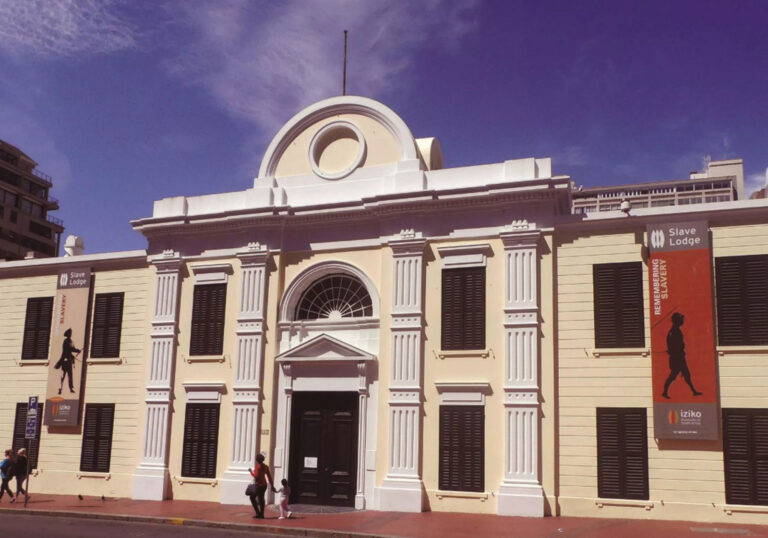
Enslaved people were part of everything that happened on and around the square. They carried the produce, worked the surrounding households and made up much of the labour of the early town, and Greenmarket Square is commonly named among the places in the old central city where enslaved people were bought and sold. That history is set out properly at the Slave Lodge, a few minutes' walk down Adderley Street.
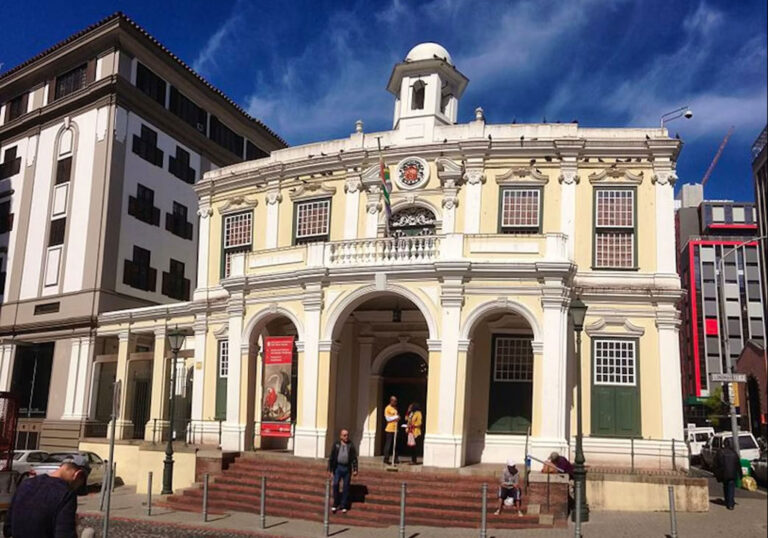
In 1755 the watch house was replaced by a larger building on the same site: the Cape rococo structure now known as the Old Town House. It housed the burgher council, then served as Cape Town's town hall for much of the nineteenth century, which meant that for decades the square was simultaneously the town's marketplace and the seat of its local government. The buildings around it kept pace with the town. Thatched single-storey dwellings gave way to flat-roofed houses of two and three storeys through the eighteenth century, and by about 1840 almost nothing single-storey survived on the square.
Greenmarket Square lost its central role in 1905, when the new Cape Town City Hall opened beside the Grand Parade and both the civic administration and much of the trading moved with it. What followed was commercial rather than civic. Through the 1930s a run of Art Deco office buildings went up around the square, including Market House, Namaqua House and, on the southern corner, Newspaper House, completed in 1936 as the home of the Cape Times and the Cape Argus. The result is the mix a visitor sees now: an eighteenth-century town house, a large Victorian Gothic church and a set of confident 1930s office blocks facing each other across the same cobbles.
Its lowest point came in the 1950s, when the square was turned into a car park. The granite setts that surface it today were laid in the 1960s, using stone lifted from streets being upgraded elsewhere in the city and dressed by hand. The square and the buildings around it were declared a national monument on 17 February 1961. During the 1980s traders began putting up stalls on the parking area, at first only a couple of days a week and then daily, and market trading returned to a square that had lost it eighty years earlier. The same decade gave the square its best-known moment in modern politics: on 2 September 1989, days before South Africa's racially segregated parliamentary elections, a police water cannon loaded with purple dye was turned on thousands of anti-apartheid demonstrators here. A protester climbed onto the vehicle and redirected the jet, and the office blocks around the square were left stained purple several storeys high. It is remembered as the Purple Rain protest.
The square's role as a place where the city's tensions become visible did not end with apartheid. From October 2019 several hundred refugees and asylum seekers occupied Greenmarket Square and the Central Methodist Mission beside it, demanding resettlement outside South Africa after a period of xenophobic violence in the country. The occupation lasted almost six months and ended in early April 2020, when those still on the square were relocated by the authorities.
Trading on the square today is craft and curio rather than produce. Stalls carry wood and soapstone carvings, beadwork, wire art, printed and woven fabric, paintings, jewellery, leather sandals, drums and masks, and a great deal of the stock comes from elsewhere on the continent rather than from Cape Town, which has made this one of the more visibly pan-African spaces in the city centre. Trading is regulated by the City of Cape Town, which allocates bays under an approved trading plan, and a revised plan covering the square and the surrounding central-city trading areas was adopted in 2026. The important thing for a visitor to understand is that the market and the square are not the same thing. The square is permanent. The number of stalls, the mix of goods and the intensity of trading all change, and on a wet winter weekday the square can be close to empty.
The square is smaller than photographs of it suggest, a shallow rectangle of cobbles with a scatter of mature trees, split by Burg Street, and enclosed tightly enough that Table Mountain appears above the rooflines rather than across open ground. Under the trees the stalls stand in rows with narrow lanes between them, and around the edges cafes and restaurants put tables out onto the cobbles. Traders will approach you and bargaining is normal; this is a working market rather than a display. It is also a busy central-city square, so the ordinary city-centre care applies: bags closed and in front of you, valuables out of sight. The cobbles are uneven and hard going for prams and wheelchairs.
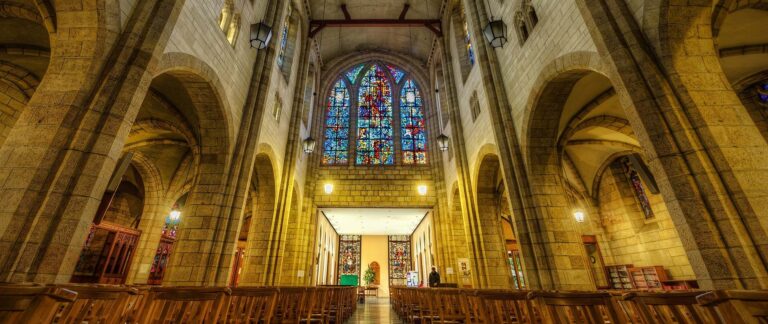
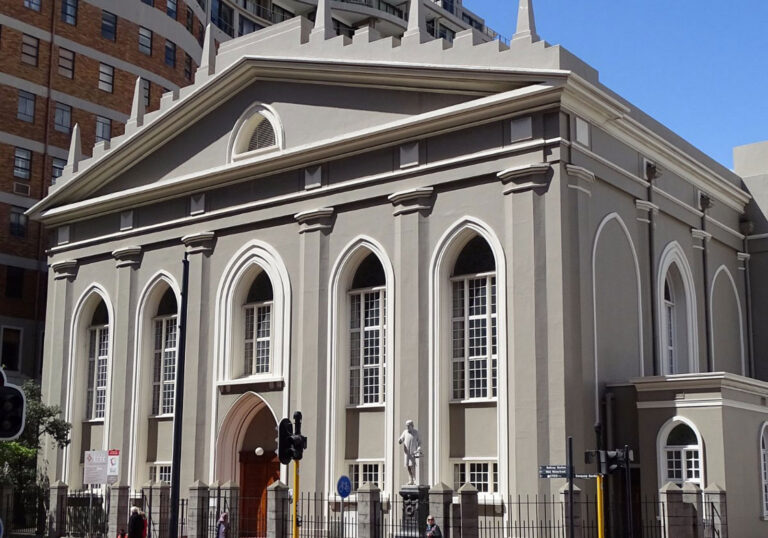
The one building on the square you can go into as a visitor is the Old Town House, the white rococo building with the small belfry, which now holds the Michaelis Collection of Dutch and Flemish paintings and keeps its own hours and admission charges. On the Burg Street corner stands the Central Methodist Mission, built as the Metropolitan Methodist Church between 1876 and 1879 and still an active congregation with a long record of social and political involvement in the city. Greenmarket Square works best as one stop on a walk rather than a destination on its own: St George's Mall runs off one corner, Long Street is a block away, and Adderley Street, the Slave Lodge, St George's Cathedral, Groote Kerk and the Company's Garden are all within about five minutes on foot.
Highlights
- A public square in continuous use since the 1690s
- Hand-dressed granite cobbles under a scatter of mature trees
- The Old Town House, the city's first town hall, stands on the square
- Victorian Gothic church and 1930s Art Deco offices on the same block
- Open-air craft and curio market with traders from across Africa
- Site of the Purple Rain protest against apartheid in September 1989
Tips
Come late morning on a weekday if you want the market at its fullest and the square at its calmest. Bargaining is expected, so decide what you are willing to pay before you start. Ask before photographing traders or their stalls. The cobbles are uneven and hard going for prams and wheelchairs. Keep bags closed and in front of you.
Frequently Asked Questions
Why is it called Greenmarket Square?
Because it began as the town's fresh-produce market. Vegetables from the Dutch East India Company's garden, and later produce brought in by farmers from the surrounding district, were sold on this open ground. The name outlasted the vegetable trade by well over a century.
What are Greenmarket Square's opening hours?
The square itself is an open public space with a street running through it, so there is nothing to open or close and no entry fee. The market on it is a different matter. Stalls are generally set up Monday to Saturday from around 09:00 until mid to late afternoon, with Sunday usually quiet or empty, but individual traders set their own times and published hours are not always current. If the market is the reason you are going, aim for a weekday late morning and confirm before travelling if you are coming a long way.
What can you buy at Greenmarket Square?
Craft and curio goods: wood and soapstone carvings, beadwork, wire art, printed and woven fabric, paintings, jewellery, leather sandals, drums and masks. Much of the stock is sourced from elsewhere in Africa rather than from Cape Town. Bargaining is part of how the market works.
Where is Greenmarket Square?
In the middle of Cape Town's city centre, between Longmarket and Shortmarket streets, with Burg Street running through the square itself. St George's Mall runs off one corner and Long Street is a block away. The square has no street number of its own.
Can you go inside any of the buildings on the square?
The Old Town House can be visited. It holds the Michaelis Collection of Dutch and Flemish paintings and sets its own opening hours and admission charges, separate from anything happening on the square. The Central Methodist Mission on the Burg Street corner is a working church rather than a museum.
Is Greenmarket Square worth visiting?
If you want a single monument to stand in front of, no. If you are interested in how central Cape Town came to look the way it does, this is one of the most layered blocks in the city, with an eighteenth-century town house, a Victorian church and 1930s office buildings facing each other across cobbles that have been a marketplace on and off since the 1690s. It is also on the way to most of the central-city landmarks, so it costs very little to include.