
Time Out Market
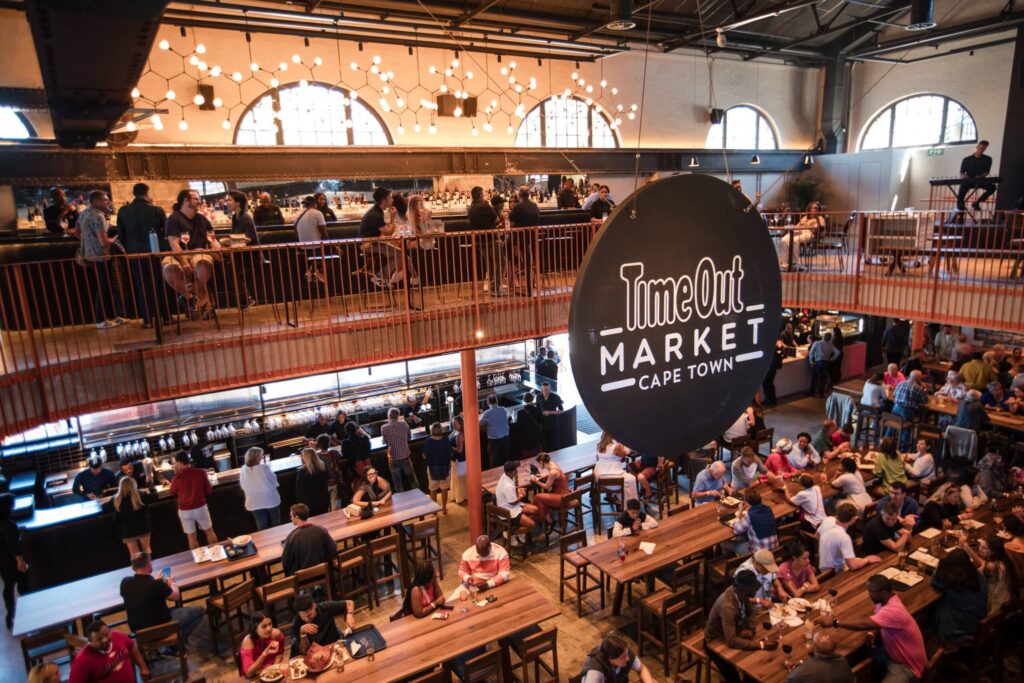
The V&A Waterfront outpost of the global Time Out brand, and the one to choose when a group cannot agree. Dishes from chefs and restaurants across the city under one roof, open from late morning until late, seven days a week.
Time Out Market Cape Town is a chef-led food hall where a rotating selection of the city’s most respected kitchens cook side by side. Every vendor is chosen by Time Out’s editors rather than simply renting a stall, so the line-up reflects genuine critical judgement about where the city is eating well.
That carefully curated mix is what makes Time Out different. Instead of committing to a single restaurant for the evening, you’re choosing from a shortlist that Time Out’s food editors have already selected for quality and variety.
Open from late morning until late evening, Time Out Market fits naturally into almost any Waterfront visit. Whether you’re stopping for lunch, meeting friends after work or looking for dinner before an evening on the harbour, free entry makes it easy to drop in without planning your day around it.
Food Experience
Time Out Market brings together some of Cape Town’s best-known restaurants and independent food businesses under one roof. Rather than dozens of similar food stalls, each kitchen offers its own speciality, giving visitors the chance to sample different flavours in a single meal.
Ordering happens across the hall rather than at one counter. A group can split up, order from different kitchens and still sit down together, which makes it genuinely useful for people whose tastes do not match. Communal tables are central to the layout rather than an afterthought.
The mood shifts as the day goes on, from a relaxed midday meal to a busier, more social evening once the bar counters fill. The hall is level throughout and comfortable in any weather, so it holds up as well for a quick stop as for a long evening.
Mojo Market
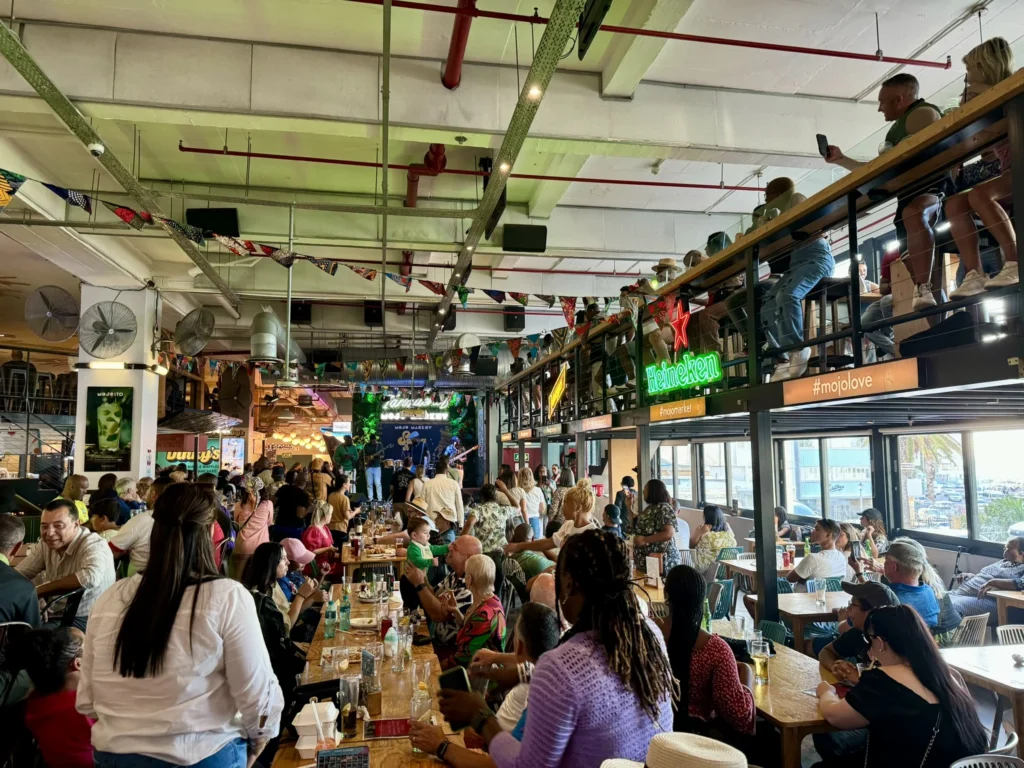
A permanent indoor food hall just off the Sea Point promenade, with global street-food stalls, bars and a live-music stage. Coffee from eight in the morning and food into the evening, which makes it the closest thing here to a night out rather than a lunch.
Mojo Market is a vibrant indoor food and lifestyle market in the heart of Sea Point, just steps from the famous beachfront promenade. It brings together international street food, local favourites, craft drinks, live music and a relaxed social atmosphere under one roof.
Unlike traditional weekend markets, Mojo Market stays open late into the evening, making it as popular for dinner and drinks as it is for a casual daytime visit. Whether you’re stopping for coffee after a walk along the promenade or meeting friends for live music and dinner, the market offers something throughout the day.
Open every day with free entry, Mojo Market is one of the easiest places in Cape Town to enjoy different cuisines in a single visit. Its central Sea Point location also makes it easy to combine with the promenade, Green Point Park, the V&A Waterfront or a sunset along the Atlantic coast.
Market Experience
Mojo Market is arranged as a collection of independent kitchens surrounding shared indoor seating, allowing groups to order from different vendors while eating together. Coffee is served from early morning, while food stalls, bars and the live music stage become the focus as the day progresses.
The market is known for its relaxed social atmosphere, combining casual dining with craft drinks and regular live entertainment. Unlike many food markets that operate only on weekends, Mojo stays lively throughout the week and is equally suited to a quick lunch, family outing or evening with friends.
The fully covered indoor setting makes it a popular choice throughout the year, particularly on windy or rainy days when the nearby promenade is less appealing.
How to Get There
Mojo Market is located on Regent Road in Sea Point, just a short walk from the Sea Point Promenade. It is easy to reach by car, ride-hailing services and the MyCiTi bus network, making it one of Cape Town’s most accessible food markets.
Paid parking is available in the surrounding streets and nearby public parking areas, although spaces become busier during evenings and weekends.
Watershed Market
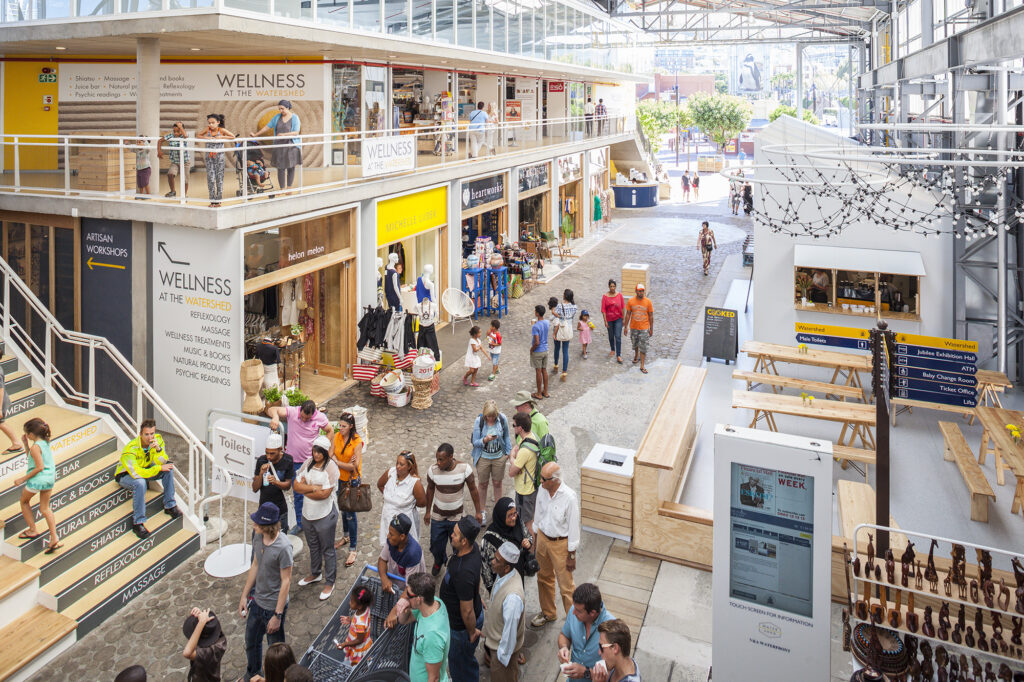
The Waterfront’s design and craft market rather than a food one, in a bright converted warehouse. Hundreds of South African makers showing fashion, jewellery, art and homeware, open every day from ten until six.
Set inside a converted warehouse at the V&A Waterfront, the Watershed is Cape Town’s leading destination for South African design, craftsmanship and locally made products. Since opening in 2014, it has grown into the largest curated design market on the continent, bringing together more than 150 makers and over 360 local brands beneath one roof.
Unlike a traditional shopping centre, the Watershed focuses on independent creators and small businesses, giving visitors the opportunity to discover authentic South African design while meeting many of the people behind the products. Its central location beside the Two Oceans Aquarium also makes it an easy stop during a day exploring the V&A Waterfront.
Open every day with free entry, the Watershed is ideal for anyone looking for unique gifts, locally made souvenirs or simply an enjoyable hour of browsing. Weekday mornings are generally quieter, while weekends offer a livelier atmosphere as both locals and visitors explore the Waterfront.
Market Experience
The Watershed brings together an exceptional collection of South African designers, artists and independent makers inside a bright, contemporary warehouse overlooking the harbour. Visitors can browse locally produced fashion, jewellery, ceramics, artwork, home décor, leather goods, accessories and handcrafted gifts, with many stalls run by the people who create the products themselves.
Although shopping is the main focus, visitors will also find cafés, artisan coffee, baked treats and light meals throughout the market, making it easy to pause without leaving the building. New designers regularly join the collection, so each visit offers something different, even for returning visitors.
The market is fully wheelchair accessible and easy to explore thanks to its spacious indoor layout and wide walkways. Its position in the heart of the V&A Waterfront also makes it simple to combine with nearby attractions such as the Two Oceans Aquarium, harbour cruises or Time Out Market, creating a relaxed half-day experience.
Greenmarket Square
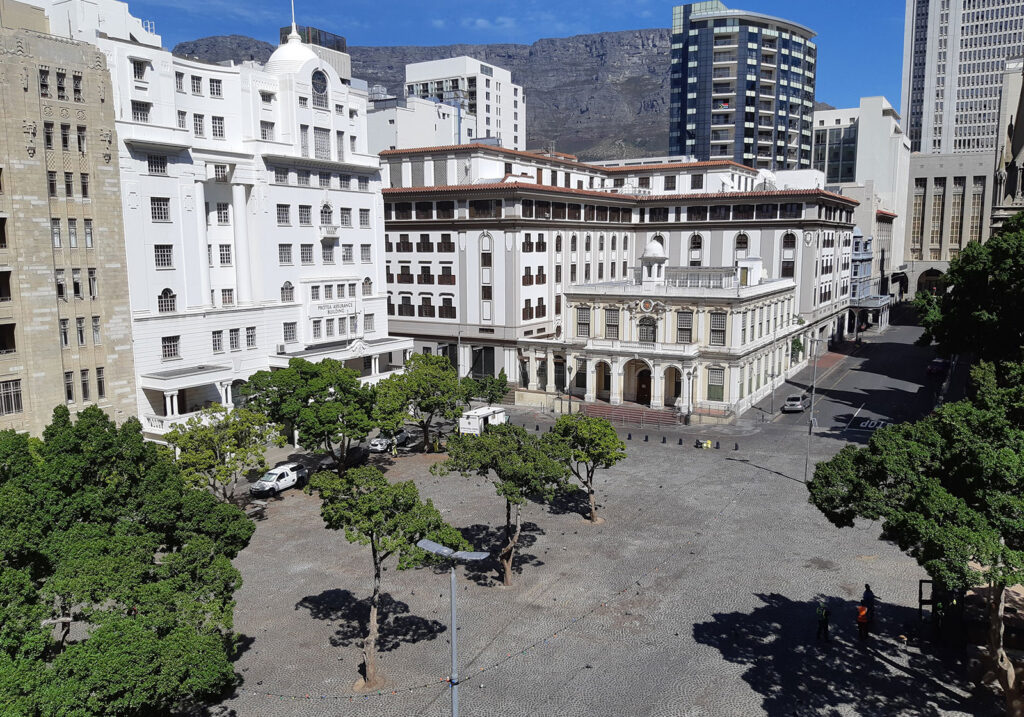
Not a market hall but a cobbled public square, bounded by Longmarket and Shortmarket streets and in continuous use for more than three hundred years. Traders returned to it in the 1980s and have been there daily since. Come for the square and the trade around it rather than for a meal.
Greenmarket Square sits in the middle of Cape Town’s city centre, a cobbled open space bounded by Longmarket and Shortmarket streets with Burg Street running straight through the middle of it. It is generally described as the city’s second-oldest public square after the Grand Parade, and the ground in front of the Old Town House door is treated as the historical centre of Cape Town. What makes it worth walking to is not any single building but the fact that this one block has been in continuous use, in one form or another, for more than three hundred years.
The square was never designed. It formed. The Dutch East India Company’s garden, a few hundred metres up the hill, was planted to supply passing ships, and produce from it was brought down to this open ground to be sold to the townspeople. Farmers and freed slaves from the surrounding district followed with wagons and carts, and the space settled into its role as the town’s fresh-produce market. That is where the name comes from. In 1696 a burgher watch house was built here, giving Cape Town’s civilian militia a base from which to patrol the streets at night, and from that point the square was both the commercial and the administrative centre of the settlement.
Enslaved people were part of everything that happened on and around the square. They carried the produce, worked the surrounding households and made up much of the labour of the early town, and Greenmarket Square is commonly named among the places in the old central city where enslaved people were bought and sold. That history is set out properly at the Slave Lodge, a few minutes’ walk down Adderley Street.
In 1755 the watch house was replaced by a larger building on the same site: the Cape rococo structure now known as the Old Town House. It housed the burgher council, then served as Cape Town’s town hall for much of the nineteenth century, which meant that for decades the square was simultaneously the town’s marketplace and the seat of its local government. The buildings around it kept pace with the town. Thatched single-storey dwellings gave way to flat-roofed houses of two and three storeys through the eighteenth century, and by about 1840 almost nothing single-storey survived on the square.
Greenmarket Square lost its central role in 1905, when the new Cape Town City Hall opened beside the Grand Parade and both the civic administration and much of the trading moved with it. What followed was commercial rather than civic. Through the 1930s a run of Art Deco office buildings went up around the square, including Market House, Namaqua House and, on the southern corner, Newspaper House, completed in 1936 as the home of the Cape Times and the Cape Argus. The result is the mix a visitor sees now: an eighteenth-century town house, a large Victorian Gothic church and a set of confident 1930s office blocks facing each other across the same cobbles.
Its lowest point came in the 1950s, when the square was turned into a car park. The granite setts that surface it today were laid in the 1960s, using stone lifted from streets being upgraded elsewhere in the city and dressed by hand. The square and the buildings around it were declared a national monument on 17 February 1961. During the 1980s traders began putting up stalls on the parking area, at first only a couple of days a week and then daily, and market trading returned to a square that had lost it eighty years earlier. The same decade gave the square its best-known moment in modern politics: on 2 September 1989, days before South Africa’s racially segregated parliamentary elections, a police water cannon loaded with purple dye was turned on thousands of anti-apartheid demonstrators here. A protester climbed onto the vehicle and redirected the jet, and the office blocks around the square were left stained purple several storeys high. It is remembered as the Purple Rain protest.
The square’s role as a place where the city’s tensions become visible did not end with apartheid. From October 2019 several hundred refugees and asylum seekers occupied Greenmarket Square and the Central Methodist Mission beside it, demanding resettlement outside South Africa after a period of xenophobic violence in the country. The occupation lasted almost six months and ended in early April 2020, when those still on the square were relocated by the authorities.
Trading on the square today is craft and curio rather than produce. Stalls carry wood and soapstone carvings, beadwork, wire art, printed and woven fabric, paintings, jewellery, leather sandals, drums and masks, and a great deal of the stock comes from elsewhere on the continent rather than from Cape Town, which has made this one of the more visibly pan-African spaces in the city centre. Trading is regulated by the City of Cape Town, which allocates bays under an approved trading plan, and a revised plan covering the square and the surrounding central-city trading areas was adopted in 2026. The important thing for a visitor to understand is that the market and the square are not the same thing. The square is permanent. The number of stalls, the mix of goods and the intensity of trading all change, and on a wet winter weekday the square can be close to empty.
The square is smaller than photographs of it suggest, a shallow rectangle of cobbles with a scatter of mature trees, split by Burg Street, and enclosed tightly enough that Table Mountain appears above the rooflines rather than across open ground. Under the trees the stalls stand in rows with narrow lanes between them, and around the edges cafes and restaurants put tables out onto the cobbles. Traders will approach you and bargaining is normal; this is a working market rather than a display. It is also a busy central-city square, so the ordinary city-centre care applies: bags closed and in front of you, valuables out of sight. The cobbles are uneven and hard going for prams and wheelchairs.
The one building on the square you can go into as a visitor is the Old Town House, the white rococo building with the small belfry, which now holds the Michaelis Collection of Dutch and Flemish paintings and keeps its own hours and admission charges. On the Burg Street corner stands the Central Methodist Mission, built as the Metropolitan Methodist Church between 1876 and 1879 and still an active congregation with a long record of social and political involvement in the city. Greenmarket Square works best as one stop on a walk rather than a destination on its own: St George’s Mall runs off one corner, Long Street is a block away, and Adderley Street, the Slave Lodge, St George’s Cathedral, Groote Kerk and the Company’s Garden are all within about five minutes on foot.
Neighbourgoods Market
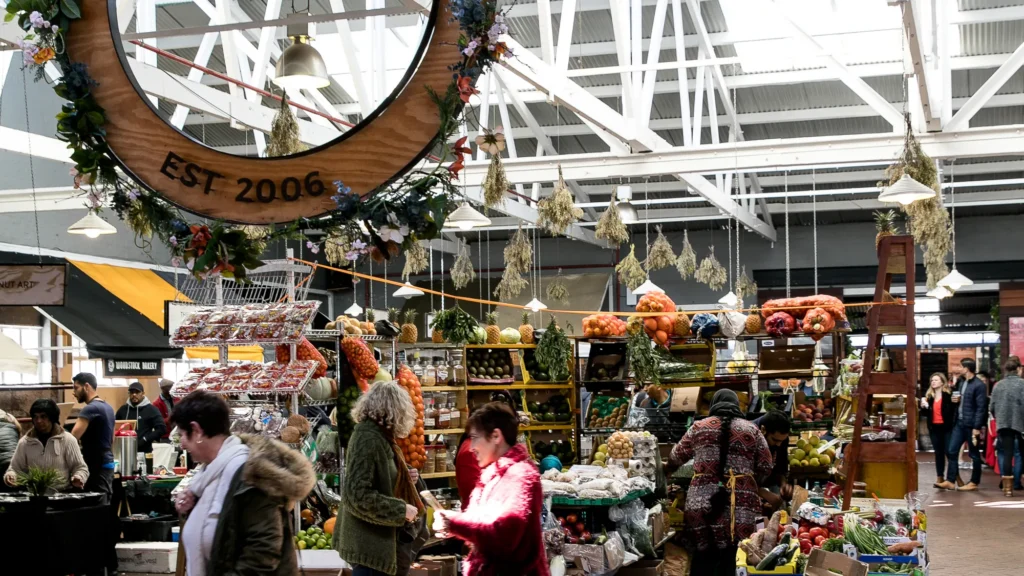
The Saturday and Sunday market at the Old Biscuit Mill in Woodstock, and the one that started Cape Town’s market culture. Saturday is busy and Sunday is calmer, with food traders and independent makers in the same yard.
Few places have shaped Cape Town’s Saturday morning culture quite like the Old Biscuit Mill. Neighbourgoods Market opened inside the converted Woodstock mill and turned a working industrial yard into a weekend habit that much of the city still keeps.
What sets it apart from the other weekend markets is the neighbourhood around it. Woodstock is Cape Town’s creative quarter, a run of galleries, design studios and workshops along Albert Road, and the market sits inside that world rather than beside it. Plenty of visits carry on into the surrounding streets long after the last coffee.
It trades across the full weekend, and the two days are not the same market. Saturday is the busy one, shoulder to shoulder by mid-morning and best reached early. Sunday is shorter and considerably calmer, which makes it the better choice if you would rather browse than queue.
Market Experience
Food dominates the ground floor, with traders cooking to order along a tight run of stalls. Portions are small enough to justify three or four of them, which is the point: most people walk the row once to look and again to commit. Breakfast is the anchor, from pastries and eggs through to slow coffee taken standing up.
Around the edges the balance shifts towards things you take home. Small-batch pantry goods, ceramics, jewellery and prints are sold by the people who made them, and the range reflects Woodstock’s studios more than any single market category.
The building carries much of the character. Exposed brick, steel roof trusses and a courtyard that overflows by late morning give it a warmth that newer venues struggle to copy. Communal tables fill quickly, strangers share benches, and dogs on leads are a normal part of the crowd.
How to Get There
The Old Biscuit Mill sits on Albert Road in Woodstock, a short drive from the city centre. Parking is the main thing to plan for. Street parking runs along Albert Road and the side streets either side of the Mill, but it fills quickly on Saturdays. There is limited paid parking at the College of Cape Town across the road, charged at around R20 for the day.
MyCiTi route 261 stops at the Old Biscuit Mill, and route 102 stops about 100m away in Salt River Road. Albert Road has a dedicated cycle lane running past the market, and there are bicycle racks on site.
Oranjezicht City Farm Market
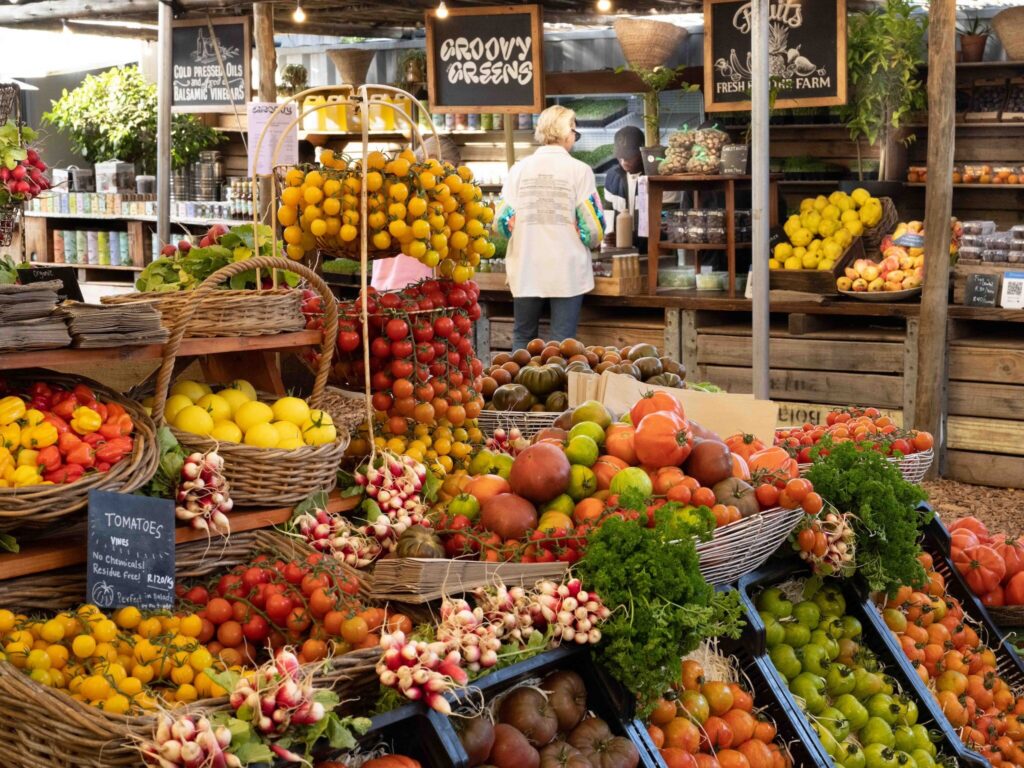
A weekend gathering on the grassy shoreline at Granger Bay, grown out of a community urban-farming project, with the ocean on one side and the mountain behind. Saturday and Sunday mornings, and a Wednesday too.
The Oranjezicht City Farm Market, known locally as the OZCF Market, began as a community urban-farming project and has grown into one of the city’s defining weekend rituals. Today the market takes place at Granger Bay, with the Atlantic Ocean on one side and Table Mountain rising behind it.
What separates it from a general food market is that traceability is the entire point. Growers and producers sell what they have grown or made themselves, so a conversation with the person behind the table is part of the visit rather than a bonus.
It runs on Saturday and Sunday mornings through to early afternoon, with a separate Wednesday evening session for most of the year. Entry is free and the setting is entirely outdoors, which makes it a natural start to a weekend day rather than something to build one around.
Farmers Market Experience
Stalls open with seasonal fruit and vegetables, much of it picked within a day or two, alongside bread from small bakeries, cheese, eggs, honey and cut flowers. Because the line-up follows the season rather than a fixed roster, what is on the tables in February looks quite different to July.
A large share of the market is given over to breakfast and brunch cooked on the spot, from pastries and slow coffee through to hot plates eaten at shared trestle tables. A smaller group of makers sells preserves, baked goods and household basics alongside them, though the emphasis stays firmly on food rather than shopping.
The mood is unhurried and distinctly local, with dogs, prams and long queues for coffee all part of it. Everything happens outdoors under open sky and canvas, so weather shapes a visit here in a way it does not at the indoor markets, and the best of it is over by early afternoon.
Bay Harbour Market
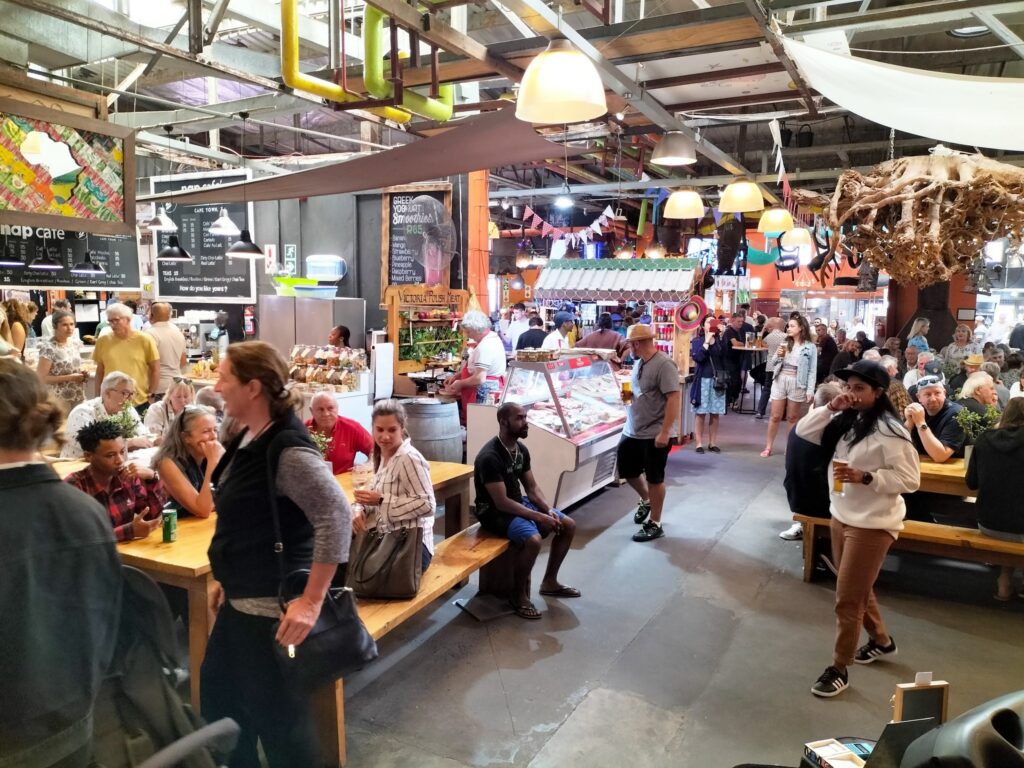
Hout Bay Harbour on a Friday evening or a weekend day: local food, handcrafted goods and live music in a working harbour. It runs latest of any market here, until nine on a Friday.
Located inside the historic Hout Bay Harbour, Bay Harbour Market is one of Cape Town’s most popular indoor attractions, bringing together local food, artisan shopping and live entertainment beneath one roof. Housed inside a converted fish factory, the market combines the character of a working harbour with a lively atmosphere that attracts both locals and visitors throughout the year.
Whether you’re stopping for lunch, looking for unique South African gifts or simply enjoying live music with a view of the harbour, the market offers an easy way to experience several sides of Cape Town in a single visit. Its indoor setting also makes it an excellent choice during colder, windy or rainy weather.
Combined with nearby attractions such as Hout Bay Beach, Chapman’s Peak Drive and Seal Island boat trips, Bay Harbour Market is an easy addition to any day exploring the Hout Bay area.
Market Experience
Bay Harbour Market brings together independent food vendors, local designers, artists and makers inside a beautifully restored industrial warehouse overlooking Hout Bay Harbour. The market offers an impressive variety of freshly prepared food, ranging from gourmet burgers, seafood and South African favourites to international street food, baked treats, desserts, locally roasted coffee, craft beer and other drinks.
Beyond the food, visitors can browse clothing, jewellery, artwork, ceramics, home décor and handcrafted gifts created by South African businesses and artisans. Many of the stalls are operated by the makers themselves, giving the market a more personal atmosphere than a traditional shopping centre.
Families are welcome, and the indoor layout provides wide walkways, level access and communal seating throughout the venue. Regular live music adds to the atmosphere, especially during busy weekend sessions, while the sheltered setting makes the market enjoyable throughout the year regardless of the weather.